The AI voice agent picks up at 2am. It takes the booking. It sounds fine. Monday morning the tenant walks in, points at the confirmation email, and asks for the unit they were promised. It's already rented. The bot didn't fail. The handoff did.
What AI actually handles well at the front desk
Rate quotes, gate hours, unit availability lookups, payment retries, after-hours booking, "when do you close." The current wave of self-storage AI voice agents handles this routine work reliably, in more than ten languages, around the clock. That is a real gain. It is also the ceiling of what any AI agent can do without human backup.
Where the handoff breaks down
The 20% that needs judgement is where the design gets tested. A tenant frustrated about a rate change. A payment failure that is actually a lockout risk. An access alert that does not match the camera footage. A double-booking created by the exact stack that was supposed to prevent it. None of that resolves from a script.
The failure mode is almost always the same shape. The bot handles the routine cleanly, then hands off to a human with a transcript dump and no context. The tenant explains their situation again. The staff member scrambles to reconstruct what the bot promised. The customer's opinion of the operator drops in the ten seconds between "let me get someone" and the human saying hello.
The handoff is the design, not a fallback
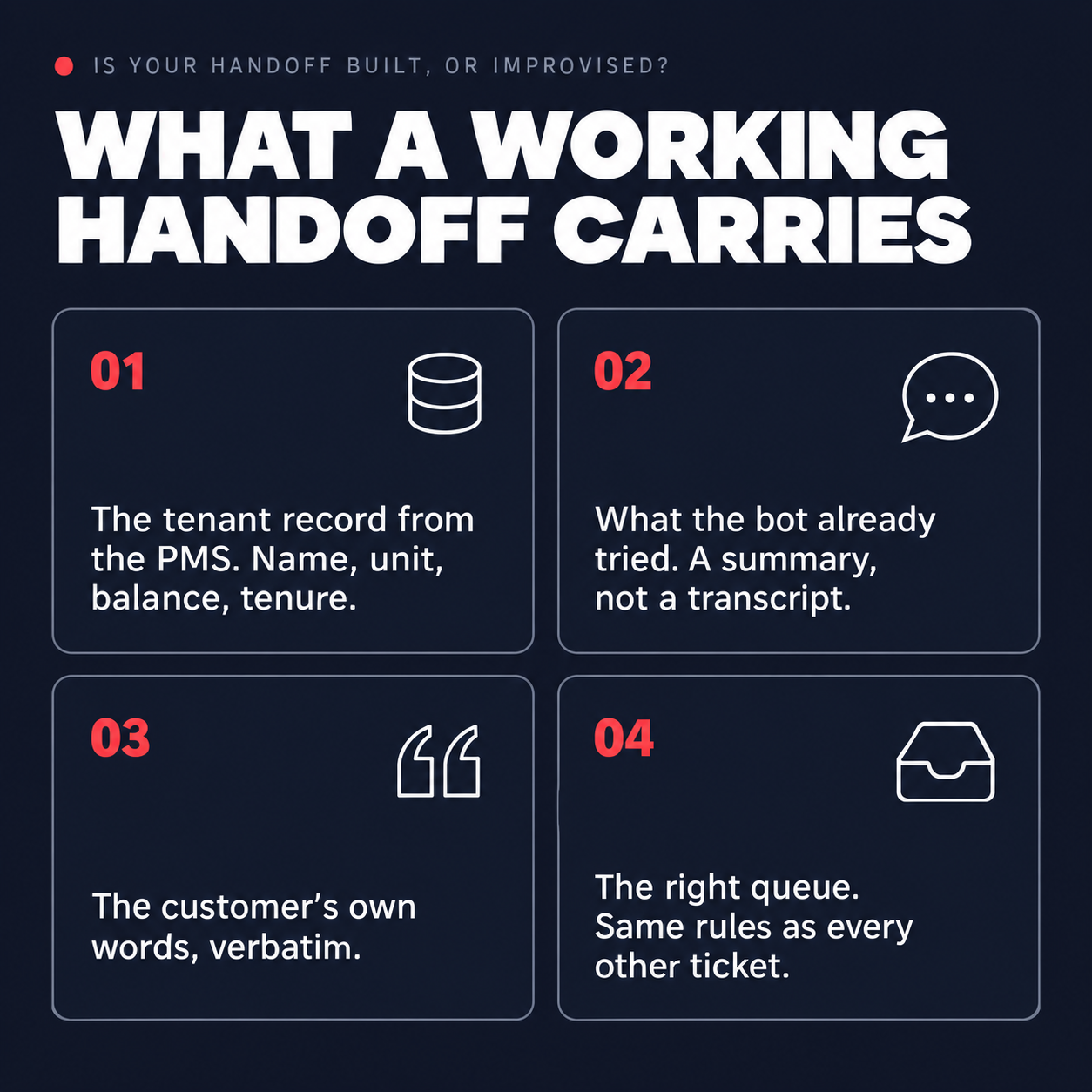
The operators getting this right treat the handoff as its own feature. When judgement is needed, the case moves with the tenant's identity, the reason for the call, what the bot already tried, and what the tenant said in their own words. The human picks up a case to decide, not a fresh start. Done well, the tenant does not notice the switch. Done badly, the AI investment gets blamed for a design gap.
Why most handoffs fail
Two patterns show up over and over. First, the bot is asked to fake empathy on cases it cannot resolve, so the tenant feels processed rather than helped by the time the human arrives. Second, the handoff is treated as an exception path, not a designed one, so context drops in the switch. Both are design choices, not AI limitations.
The same pattern hit retail this year
Storage is not alone. A retailer we spoke with rolled out an AI support bot last quarter. Tickets went up, not down. The bot cleared the easy questions. Everything hard routed to a human with no context and became a slower, angrier ticket than the pre-AI version. The mechanics are the same as a storage voice agent booking a phantom unit: a good tool dropped into a workflow instead of built into one.
Three questions to ask your vendor about handoff
Before you sign or renew, put these to the AI vendor in writing.
- What context transfers? The full transcript, tenant identity, prior attempts, and the tenant's own words. Or a dropped call and a note in a queue.
- Where does the handoff go? A named staff member with the case on their screen. Or a shared inbox nobody owns until Monday.
- How do you audit whether it worked? A dashboard that shows post-handoff resolution rate. Or "trust us."
If two of the three answers are vague, the handoff is not designed. It is assumed.
What to try this week
Pull your last ten after-hours cases handled by an AI agent. For each one, check whether the person who followed up the next morning had to ask the tenant to repeat information. If more than two did, the handoff is where your value is leaking, not the AI.
Find your leak in five questions
The AI Integration Health Check walks you through the four signs against your own stack. Two minutes, no scoring, no vendor pitch.
Common questions
The moment an AI agent (voice, chat, or SMS) passes a live case to a human with full context: the tenant's identity, the reason they made contact, what the bot already tried, and what they said in their own words. Done well, the tenant never repeats themselves when a staff member picks up the case the next morning.
Any time the case needs judgement the bot cannot defend: a payment failure with a lockout risk, a rate dispute, an access alert that does not match the camera footage, a tenant complaint about something adjacent to the ticket. Set the trigger on the shape of the case, not on tenant frustration. By the time the tenant is angry, the handoff is already late.
Two patterns. The bot fakes empathy on cases it cannot resolve, so the tenant feels processed instead of helped. Or the handoff is treated as an exception path instead of a designed one, so context drops in the switch. Both are design choices, not AI limitations
Pull your last ten after-hours cases handled by an AI agent. Check three things: did the person following up get the full context automatically, did the tenant have to repeat any information, and did the case resolve without a second escalation. If any of the three is failing regularly, the handoff design is the problem.
Yes. The same pattern hits ecommerce brands rolling out support bots, hospitality operators using AI receptionists, and any B2C service business bolting AI onto customer contact. The vertical changes. The design question does not.