You pay for market intelligence every month, you set rates and underwrite deals off it, and you keep almost none of it. That's the part of the Green Street and StorTrack story worth an operator's attention, and it has nothing to do with AI.
The news is American, the lesson isn't. Green Street acquired StorTrack on 15 July, terms not disclosed. StorTrack, founded in 2014 and based in Michigan, is the benchmark for unit-level pricing, supply and development data in US storage. The deal also brought in ListSelfStorage.com and RVParkIQ.com. Then on 11 August, Green Street made its Model Context Protocol server generally available, piping its research, market data, forecasts, sales comps and single-property valuation model straight into corporate instances of Claude, ChatGPT and Gemini. Green Street's own framing: insight that used to take hours, days or weeks now arrives in seconds.
StorTrack's unit-level rate data isn't on the dataset list for that August launch. I wouldn't plan around it staying off.
Everyone buys the same feed. Not everyone asks the same question.
It's tempting to read this as a data-access story. It isn't. Anyone can buy StorTrack. Its Optimize platform is built for operators, and StorTrack has been selling to them for more than a decade. The private equity group underwriting a portfolio two towns over is looking at the same scraped rates you are.
What changed is the cost of asking a complicated question of that data. Their analyst types it in plain language and gets markets ranked against comps and a valuation model in one pass. Your version is an export, a spreadsheet and a call to an area manager. Same facts on both sides of the table, very different hours between question and answer. In a competitive bid, that's the part that matters.
Buying more data doesn't close that gap. Neither does buying the same connector. It closes when the market feed stops being the only thing in the room. A ranked market list is an outsider's view of your own submarket. You have something the outsider doesn't - what actually happened at your counters - and the feed is only worth what your own record can do with it.
Published rates are not rates
This worries me more than the speed gap.
A market feed scrapes what facilities publish. Take a standard mid-size unit where three competitors advertise between 129 and 139 a month and you sit at 149. The feed says you're above market, and it's right about the advertised number. What it doesn't know is that two of those three are running six weeks free on new move-ins, that your in-place average on that unit size is 171 across tenants past their first year, and that your rate increases stick at a level you can measure and they can't. Published rate is an acquisition signal. In-place rate is the business.
Feed the published number into an AI pricing loop with nothing else attached and you haven't automated a good decision. You've automated a bad comparison and removed the friction that used to catch it. That's not an argument against pricing tools. It's an argument that a market feed is one input to a rate decision, never the decision, and what makes it mean something is your own in-place history sitting next to it.
Keep the receipts
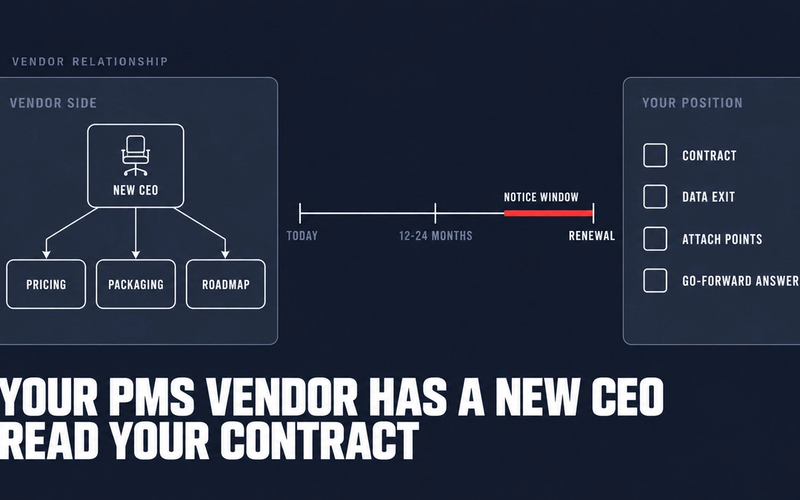
After an acquisition, terms change. Not maliciously. Coverage gets rationalised, methodology gets harmonised with the parent platform, packaging gets rebuilt, pricing tiers move. StorTrack's founder said clients keep the same tools and support they rely on today. I expect that's sincere and true for a while. "For a while" is the operative part. Vendors get integrated after they get bought, because that's the point of buying them.
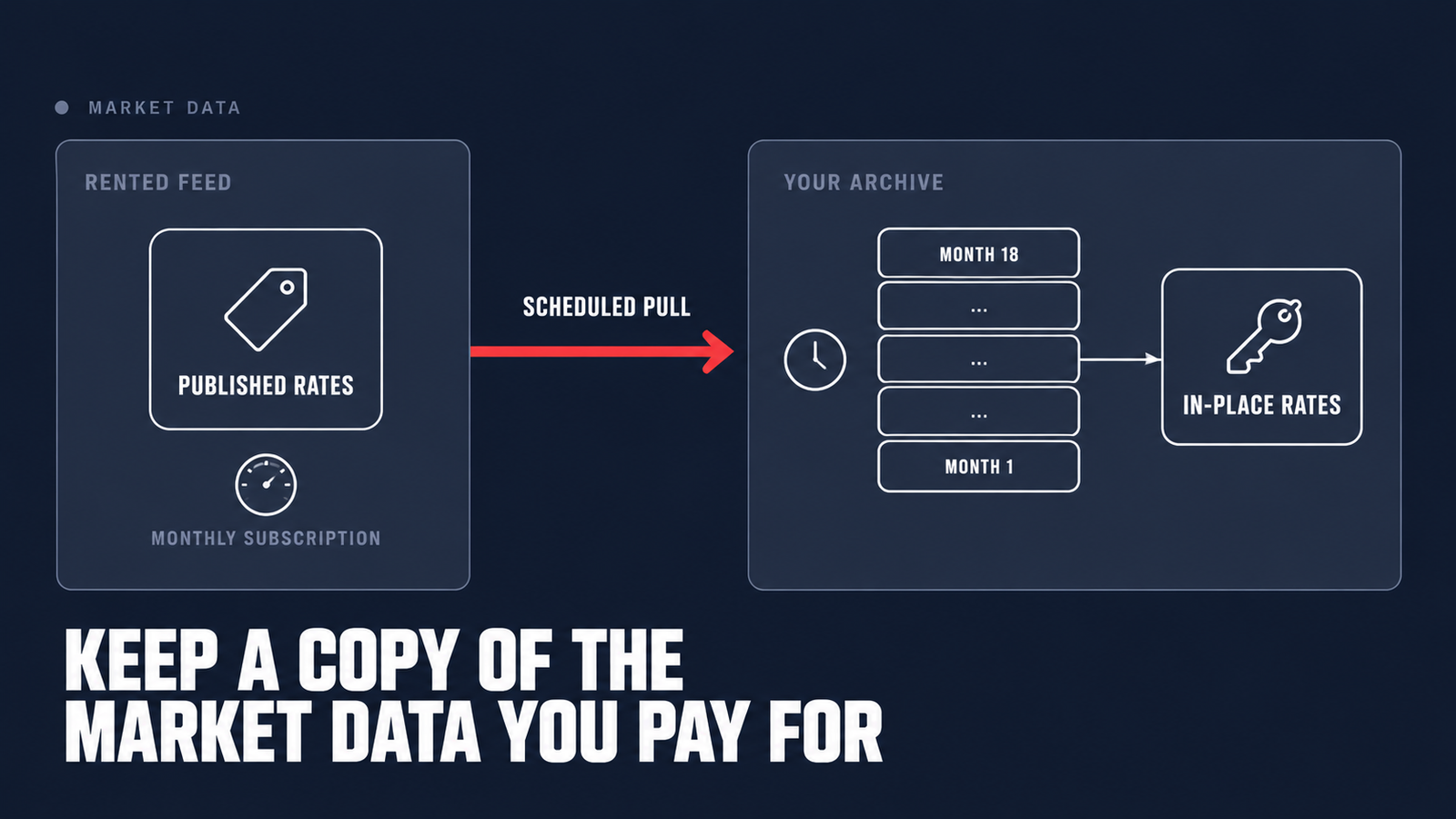
So a question before your next renewal, whichever feed you use: if it changed shape tomorrow, could you still say what happened to advertised rates in your submarkets over the last eighteen months?
For most operators the answer is no, because they query the feed live and archive nothing. The subscription is treated as a window, not a source. Institutions do the opposite. They pull it, store it and build a history they own, which is why they talk in trend lines while everyone else talks about last week.
The fix is dull and cheap. Pull the market data you already pay for on a schedule, land it in your own store, timestamp it, keep it. Most feeds worth having sell an API for exactly this, StorTrack included. You get a rate history nobody can revoke, and the ability to check whether the feed's version of your market has ever matched what happened at your counter. The second is worth more than it sounds. Nothing calibrates trust in a data source like eighteen months of watching it be wrong about your own submarket in a consistent direction.
The trade-off: you now own a data pipeline. Somebody has to keep it running and somebody has to notice when it quietly stops. If you run a small cluster in one city and know every competitor by name, I don't recommend it - you already hold the history in your head and the pipeline is overhead. Past the point where you stop knowing the market by driving it, the archive is worth more than the subscription.
Vendors will keep consolidating and bolting AI front doors onto data you already buy. None of that changes the job for this quarter: getting your own record into a shape that can sit next to a market feed and argue with it.
Mapping that layer, before the next tool shows up, is where our architecture review starts.
← Back to the blog