A vendor integration announcement tells you two companies built a pipe. It does not tell you your lock-in went down, and operators who read it that way are skipping the part that matters.
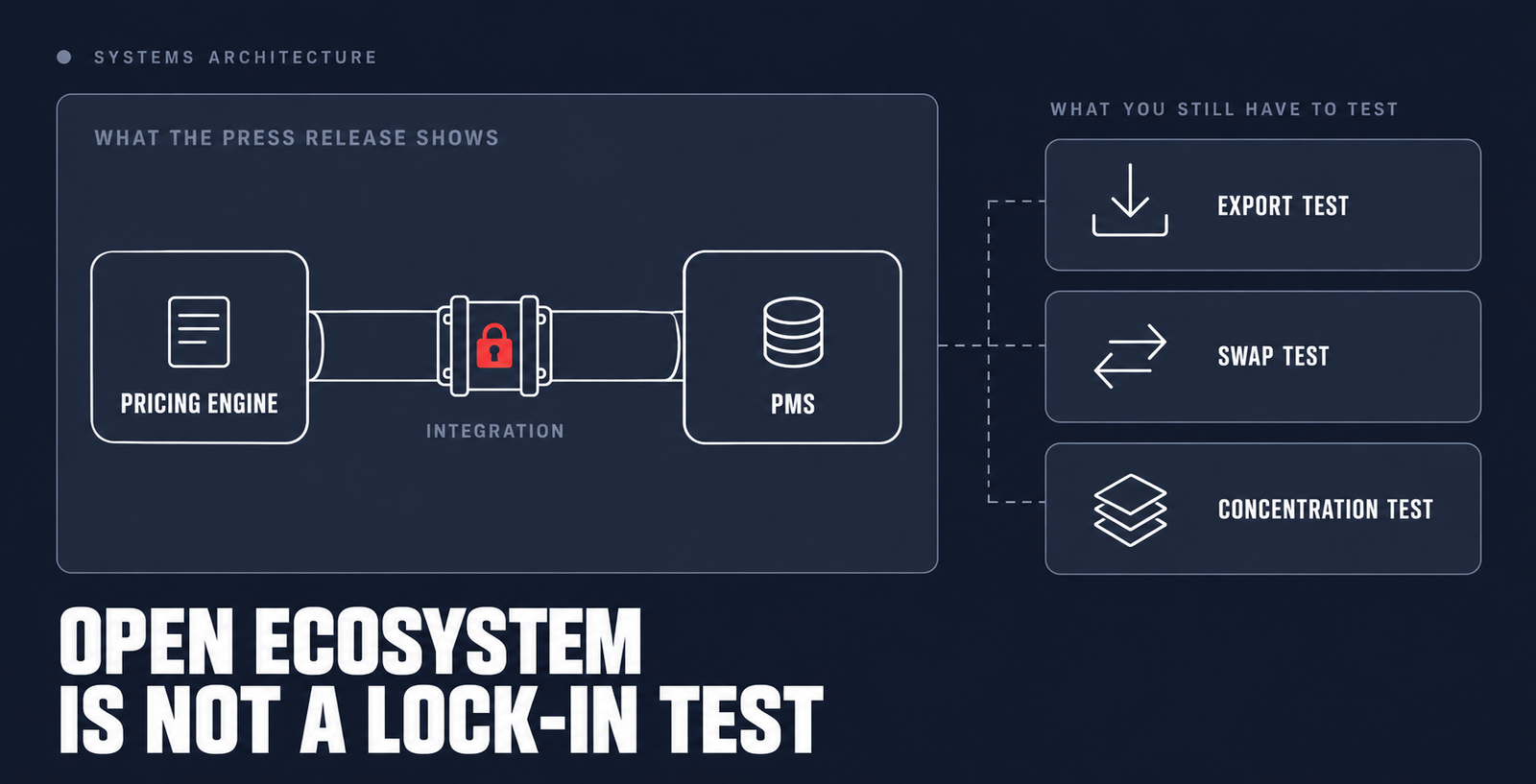
The latest example: in late August, Prorize and Monument announced a direct integration. Prorize's AI pricing engine now feeds rate recommendations into Monument's property management platform, automating the exchange of pricing and operational data that used to be handled manually. The announcement frames it as part of a "more open technology ecosystem" - interoperability instead of lock-in, with operators keeping ownership of their data.
That's a good integration. It's also a press release, and those are two different claims.
What the announcement actually tells you
The engineering is real. Automating the handoff between a revenue management tool and a PMS removes a manual step that used to add lag and errors. Faster data flow between pricing and inventory is worth having. None of that is in question.
What's in question is the word "open," and whether an operator should treat a partnership announcement as evidence that their lock-in risk dropped. On its own, it didn't. Two vendors agreed to connect their systems. Nothing in that tells you what happens if you want to leave either one.
Three tests before you relax
Run these before you treat any vendor integration - this one or the next one - as reduced lock-in.
The export test. Can you pull your own rate history and occupancy data out of this stack, at the same level of detail the vendors see, in a form you can use without either vendor's help? Not a dashboard export with rounded numbers. The actual data your pricing decisions were based on. If the answer is "we'd have to ask," you don't have portability. You have a good relationship you're hoping continues.
The swap test. If you dropped either vendor tomorrow, would the other still work on your terms? An integration built so two specific partners work well together is not the same as one built so either side is replaceable. Ask it directly, before you sign: if we keep Monument and move off Prorize in eighteen months, does our pricing workflow degrade, or does it just lose one feature? That answer is the real openness test, and it isn't in the press release.
The concentration test. After the integration, how many separate systems does your rental rate depend on - and did that number go up or down? This is the one operators skip, because it sounds like process for its own sake. It isn't. When pricing logic moves from something you configure and audit inside one system to something that flows automatically between two vendors, the trail of why a specific unit's rate moved on a specific day gets harder to rebuild. You gain speed and lose visibility. That trade is fine if you made it on purpose. It isn't fine if you made it because a press release said the ecosystem was open.
What "open" usually means
I've read enough software partnership announcements over the years to know the pattern. "Rather than locking customers into a single platform" reads well. Sounds good on paper but practically, it usually means two vendors agreed not to compete with each other's core product for now, and to make their integration with each other smoother than either one's integration with anyone else.
That's a real benefit if those two products are the ones you already run. It is not evidence that switching either one later stays easy. Different claims - and only one of them made it into the release.
Adopt it on the merits, not the adjective
None of this is a case against the Prorize-Monument pairing. If you already run Monument and you're evaluating a revenue management layer, a vendor-built integration that removes manual data handling is a legitimate point in its favour, and it probably saves someone on your team real hours. Adopt it on that basis, if the workflow and the pricing lift stack up on their own.
Don't adopt it because the word "open" was in the announcement. And don't skip the three tests because two vendors told you they'd already run them. They ran a compatibility test. That's a different and much narrower thing.
The gap between an integration that works well and one that keeps you free to leave is the kind of architecture question that gets missed when technology decisions live inside the vendor relationship. Closing it is part of what our Fractional CTO engagement does.
← Back to the blog