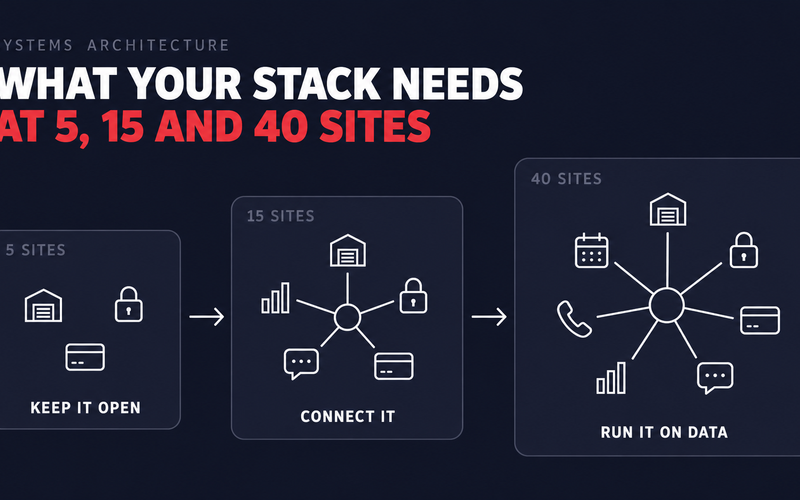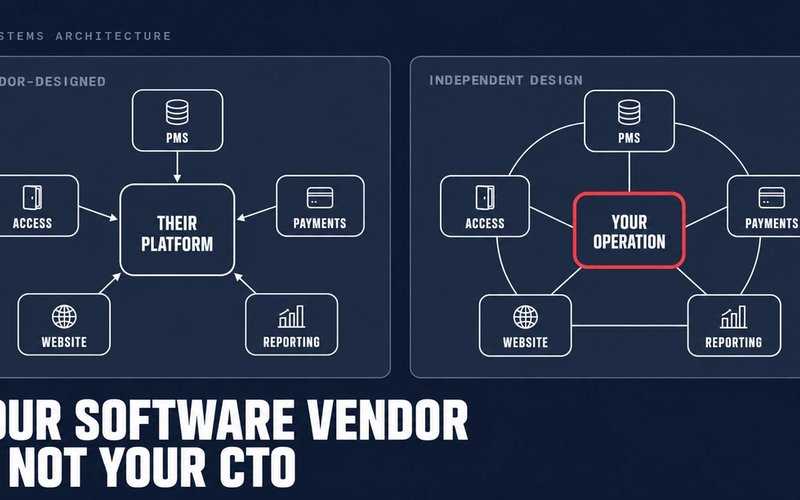
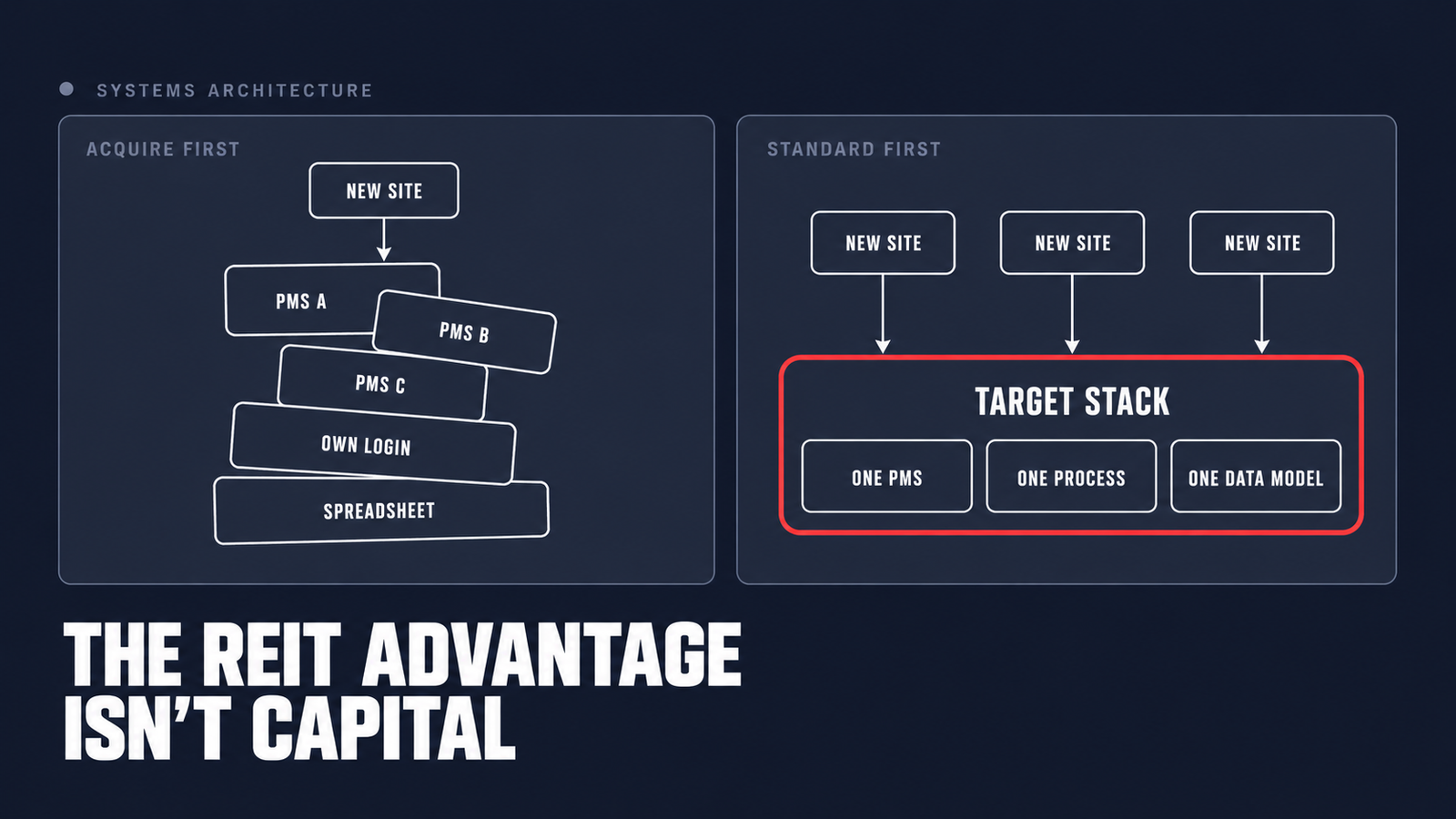
The biggest advantage a REIT has over a 5-50 site operator isn't the balance sheet. It's that every site runs the same system, and the REIT decided what that system was before it went shopping.
The latest example is from the US. Public Storage closed its $10.5 billion acquisition of National Storage Affiliates on 22 July. The headline is the size: more than 1,000 properties, 550,000 units and a combined portfolio of over 4,500 facilities. The number worth an operator's attention is smaller and quieter. Public Storage expects $110-130 million in run-rate synergies within three to four years, from revenue enhancements, operating efficiencies, tenant reinsurance uplift and G&A savings. The engine behind them is putting its "PS Next" operating model on every site NSA brought in. One set of digital tools, one centralised operations function, one PMS, one standard process.
You don't need to operate in the US, or anywhere near that scale, for this to apply. Every operator who grows by acquisition has the same problem in miniature.
What that number is paying for
Every facility you bought came with its own PMS, its own pricing logic and its own version of how move-ins work. You inherited five different answers to the same ten questions and never had the occasion to force them into one. Public Storage has just put a price on what it's worth to stop tolerating that.
It can do this because the standardisation came first and the acquisitions second. PS Next existed before NSA closed. When a new portfolio lands, there's already a target state to move it onto, not negotiate with.
A 5-50 site operator usually runs it the other way round. Buy the facility, keep whatever it came with because ripping it out feels like the harder problem, and add another exception to a stack that is already exceptions all the way down. Ten years later you have ten sites and ten answers to "what's our occupancy right now", none of which reconcile in real time.
Sequencing, not scale
I wouldn't suggest chasing what Public Storage is doing. A company running 4,500 facilities and one running 12 are solving different problems. Buying REIT-grade software to run a dozen sites is its own mistake - I've watched operators do exactly that and pay for capacity they'll never use.
The lesson isn't the platform. It's the order of operations.
Public Storage decided what "one way of doing this" looked like before it went looking for the next acquisition. Most growing operators do it backwards: acquire first, then work out later what to do about nothing talking to anything else. By the time someone notices - usually when a lender or buyer asks for consolidated numbers and the answer takes three weeks and a spreadsheet - the fragmentation is load-bearing. Pull out one piece and you risk breaking three others nobody documented.
What it costs to skip this
The decision point isn't "should we adopt AI" or "should we centralise operations" in the abstract. It's whether the next facility you buy, or the one you're already negotiating, gets folded into a target architecture you've defined. The alternative is bolting it onto the pile with its own login and its own export format because that's fastest this month.
Fastest this month is how you end up with the mess you have now.
An architecture decision, not a shopping decision
None of this needs REIT scale. It needs you to decide, once, what your standard stack is - the system of record, the integration points, the process every site runs - and then hold new acquisitions to it instead of accommodating them. Most mid-market operators never make that decision deliberately. They make it by accident, one exception at a time, for years.
Sounds good on paper but practically, most operators I talk to can't say what their standard stack is in one sentence. That's not a knock. Nobody sat them down to design it, because there was always a more urgent fire. The REITs have now shown what that discipline is worth. Have the conversation before the next acquisition, not after.
Holding that standard across every deal, for operators without a technology lead of their own, is what our Fractional CTO engagement is for.
← Back to the blog