
Two activist investors are pushing Big Yellow, the UK's largest self-storage operator, to put itself up for sale. Their argument is a number: the shares trade around 35 percent below the value of the property on the balance sheet. Whatever happens next, the episode shows something every operator should sit with. The property gets valued by a surveyor. The business running on top of it gets valued by what a buyer can prove in a few weeks, and most of that proof lives in your systems.
What happened
Ancora, a US activist holding more than 4 percent of Big Yellow, went public on 14 October and asked the board to run a strategic review that includes a sale process. The next day the Financial Times reported a second activist, Irenic Capital Management, had built a stake of around 4 percent and had been pressing the board for months. Big Yellow said it "continually evaluates all options" and confirmed it had met the shareholder pushing for a sale. It also reminded the market that Blackstone had looked at a cash offer late last year, and that the board ended those talks because the price did not reflect the company's full potential. The market value sits around 1.65 billion pounds. Big Yellow runs 113 sites in the UK.
I have no view on Big Yellow's systems and nothing below is a comment on them. A company that size will have a data room ready. This is for the rest of us, the 5 to 50 site operators whose owners, lenders or partners could ask the same questions with a lot less warning.
What the buyer's technical team is actually pricing
A sale process runs on a clock. The buyer gets a data room and a few weeks. Their technical people are not there to admire your architecture. They are pricing three things.
The first is migration cost. If the buyer is a large operator, your stack is going somewhere. Public Storage closed its 10.5 billion dollar acquisition of National Storage Affiliates in July and told the market to expect 110 to 130 million dollars a year in synergies, most of it from putting its own operating model on every site NSA brought in. When Shurgard bought Lok'nStore for 378 million pounds, it said up front that most head office roles would go. That is what "synergies" means in this industry: one platform, one central team, everything else repriced. Your systems get valued on how cheap they are to leave.
The second is earnings quality. A buyer underwrites the rent roll, not the dashboard. If the numbers in the data room cannot be rebuilt from the systems and reconciled to the accounts, every one of them carries a haircut.
The third is what they inherit. Contracts, liabilities, data obligations, the integration only one person understands. None of this appears on an architecture diagram. All of it lands on the buyer the day after completion, so they go looking for it in week one.
You do not build the answers during the process. You find out during the process what you have.
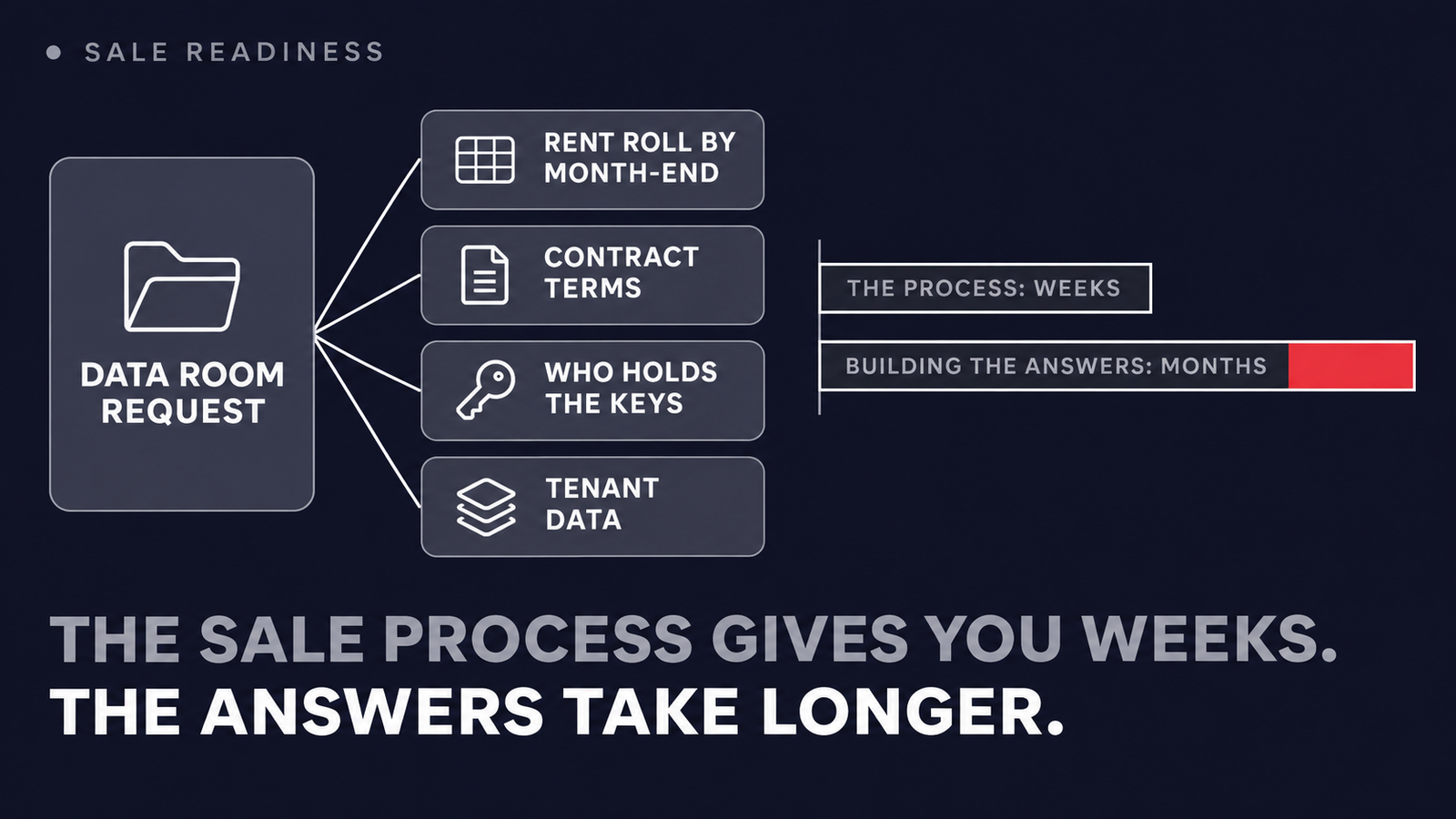
The four requests I'd expect to land first
History, not just today. Anyone can show current occupancy. A buyer wants the rent roll as it stood at each month-end for the last two or three years, reconciled to the ledger. A lot of setups report the live position well and the past badly, because history gets overwritten when a unit changes status or a rate is edited. If your monthly pack is built from exports somebody saved at the time, you cannot rebuild a month nobody saved. The buyer does not say "your reporting is weak." They say "we can only underwrite what we can verify," and the number moves.
Contracts that move with the company. Every system contract - PMS, payments, access control, call handling, website - with its renewal date, notice window, termination fee and what it says about assignment or change of control. A buyer planning to move you onto its own platform will add up exit costs you have never totalled. A contract that needs the vendor's consent to transfer is a negotiation, and you want to know about it before it sits on someone else's timetable. I've seen a platform split where the software cost was never covered in the agreement at all. Nobody noticed until the invoices started arriving at the wrong company.
Who holds the keys. Admin logins registered to a former employee's email. The API key behind a key integration created under a contractor's personal account. One person who can explain how online bookings reach the PMS, and she is on holiday. A buyer's team finds all of this in the first week by asking who can reset what. It reads as operational risk, and operational risk gets priced.
Where tenant data lives. A transaction moves tenant records, call recordings, chat transcripts. Your lawyers will want to know what you told tenants and what consent you hold. Your technical advisers will ask which AI and messaging tools keep a copy, under whose terms, and whether you can get it back out. If a voice agent vendor retains your call transcripts on its own servers, that is part of the answer, and it may not be an answer you like.
The fair version of the other side
If the buyer is a large operator, your stack may matter less than you fear. It will migrate you onto its own platform either way, and it will price the migration, not the elegance of your design. A tidy stack still helps. It makes the migration cheaper and the discount smaller, and a clean data export is the difference between a four-week migration and a four-month one.
If the buyer is private equity planning to keep you running and bolt on more sites, the picture flips. Now your stack IS the platform, and the question becomes whether it can absorb the next ten acquisitions. That is a different diligence and a much harder one to pass by accident.
Most operators will also never meet an activist. But lenders ask versions of these questions at every refinance, and joint-venture partners ask them at every capital call. The data room is just the moment the questions arrive all at once with a deadline attached.
A test for this week
Ask your finance lead for the rent roll as at a month-end two years ago, reconciled to the ledger. Ask whoever manages your suppliers for a one-page list of every system contract with its renewal date and assignment terms. Ask your operations lead who can reset the admin password on every system you run. Time all three.
Whatever takes more than a week, or cannot be produced at all, is your diligence list. You would rather write it yourself than receive it from the other side of the table.
I wouldn't suggest waiting for an approach to find out. A sale process gives you weeks. These answers take months to build, and the buyer knows that better than you do.
Pulling that list together and deciding what to fix first is the sort of work our Fractional CTO engagement covers.
← Back to the blog