The lock, the unit sensor and the keypad are turning into subscription software, and most operators are still underwriting them like hardware. That mismatch is where the expensive mistakes will come from.
Two announcements from the US market, two weeks apart, point the same way. On 8 September, West Coast Self-Storage said it will standardise StorageDefender Smart Unit and Smart Zone monitoring across its portfolio of nearly 170 locations, rolling out through Q4 2026. Two weeks earlier, OpenTech Alliance signed a letter of intent to acquire SAM Systems, maker of an NFC smart latch lock, with a keyless option expected to come in under $100 per lock and availability projected for Q1 2027.
The news is American. The question it raises applies to any operator buying smart access hardware, wherever you run.
For most of this industry's history, the physical layer was the one part of the stack you could leave out of a systems conversation. A lock was a padlock the tenant bought at the counter. The gate keypad talked to whatever access software you ran, and if you changed property management systems, nobody touched a single door. Hardware was a capital purchase - bought on price and durability, replaced when it rusted.
That model is ending. A smart latch lock is an endpoint on a vendor's platform. A unit sensor reports motion, temperature and humidity into a vendor's cloud, and the tenant pays the vendor's monthly subscription for it. The keypad authenticates against the vendor's access service. None of these devices is useful on its own. Each one is the physical tip of a software relationship, usually priced per unit per month, and increasingly sold to you as ancillary revenue rather than a cost.
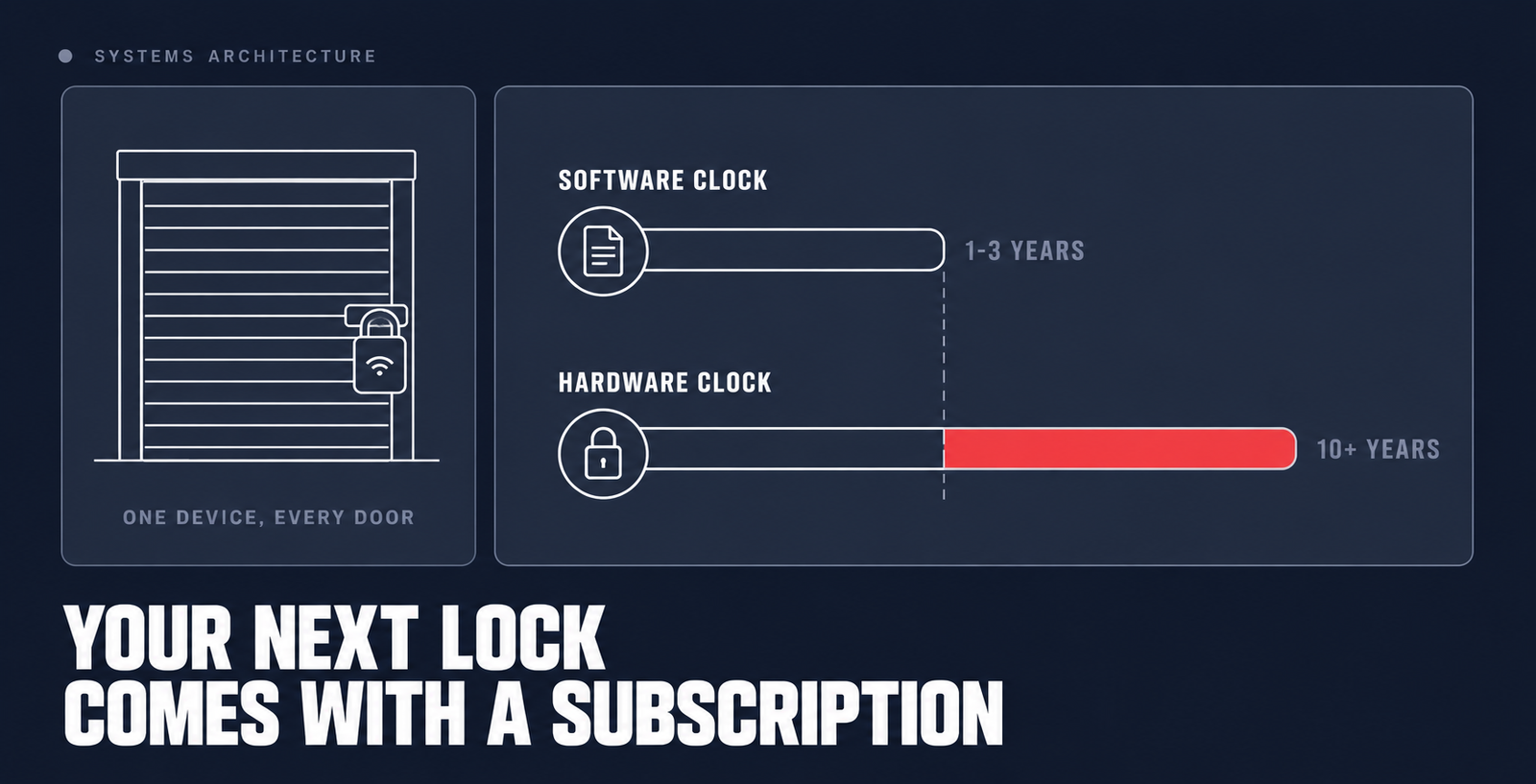
The problem isn't the technology. It's that two clocks don't match.
Two clocks
Software runs on a short clock. You sign for one to three years, and if the product disappoints, migration is painful but bounded - export the data, retrain the staff, cut over. The industry knows how to do this.
Hardware runs on a long clock. A lock or sensor goes on every door of every unit at every site, and it stays there for a decade or more, because replacing it isn't a licence fee. It's site visits multiplied by doors multiplied by sites. When you fit a vendor's device to 15,000 doors, you haven't made a software decision with some hardware attached. You've made a hardware-length commitment to a software company.
That's what it really means when a platform vendor moves to buy a lock manufacturer. The consolidation isn't sinister. It's rational, and it will keep happening. But every deal like it shrinks the pool of hardware that works independently of any one platform, and pulls the physical layer deeper into ecosystems that are priced, updated and retired on software terms.
The fair version of the other side
There are real gains here, and I'd take some of them.
One vendor accountable for the whole access path beats three vendors pointing at each other when a tenant is locked out at 9pm. A smart lock under $100 puts unit-level access within reach of operators who could never justify it at earlier prices. Tenant-paid monitoring is real revenue. And a portfolio of nearly 170 managed and owned sites converging on one monitoring layer, across sites running different systems, is the right instinct - one system per function is how you get out of fragmentation.
The move is sound. The underwriting is where operators get sloppy.
Four questions before you commit every door
Underwrite on the hardware clock, not the contract term. The question isn't whether you like this vendor for the next three years. It's whether you're willing to live with them for the life of the device on the door. Price the exit while you still have negotiating power: what does it cost, in labour and hardware, to take it all off again?
Ask the lapse question, in writing. What does the lock do the day the subscription stops? Is it still a lock, or a brick with an antenna? What happens to the sensor data - does it stop, and does your history come with you? A vendor confident in the product will answer on paper. A vendor who won't has answered a different question.
Count the revenue dependency. The ancillary revenue framing is the cleverest part of the pitch, and it cuts both ways. Once tenant monitoring fees are a line in your P&L, replacing that vendor stops being an IT project and becomes a revenue event. You're not just switching a supplier. You're unwinding income your budget has already absorbed.
Claim the data. Unit-level activity is operational data about your property and your tenants. Know where it lands, who owns it, and whether you can pull it out in full without the vendor's help. If you can't, the monitoring layer isn't reporting to you. You're reporting to it.
The access layer belongs in the architecture
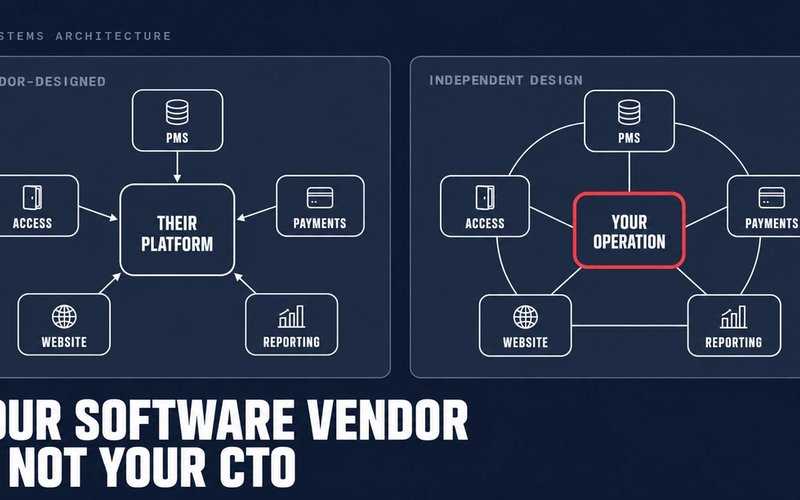
The access layer used to sit outside the architecture conversation. It now belongs inside it, next to the PMS and the payment stack, with the same scrutiny. When I map a target-state architecture for an operator, the question is never whether a given tool is good. It's what the operation depends on, for how long, and on whose terms. The physical layer just joined that list.
Better to see that dependency before you commit every door than after - which is what our Fractional CTO engagement is there to do.
← Back to the blog