Operators tell me their customers want a human connection. They're right - but not about where.
I hear this most often as a reason to slow down on automation. "Our customers value the personal touch. We don't want to become a vending machine." It sounds caring. In practice it usually means a customer waiting on hold to hear a unit price, or waiting until Monday morning for a gate code, because a person has to be involved in steps a person adds nothing to.
I operated self-storage for 13 years. Here's what I learned about what storage customers are actually going through.
A distress purchase doesn't want a chat
Nobody plans to need self-storage. Something happened - a move, a divorce, a death in the family, a landlord selling the building. Your customer arrives with a problem, a deadline, and very little patience.
In that state, what do they want from a quote? Speed. From a booking? Speed. From a payment, a gate code, an account change? Speed. For these steps, instant beats personal every single time, and it isn't close. A customer who gets a price and an access code in two minutes at 10pm thinks you're brilliant. A customer who gets a warm, friendly callback the next afternoon already rented from someone else.
Speed IS the service. That sentence sounds cold until you remember what the customer is dealing with that week.
Where the human earns their keep
Now flip it. There are moments where a fast automated answer is exactly wrong:
The first walkthrough, when a nervous customer wants to see the unit and be told it'll be fine. A billing dispute, where the customer is angry and a templated reply pours fuel on it. A flooded unit. Their grandmother's furniture is in there. A tenant in genuine distress - and in this business, you will meet them - clearing out a parent's house, mid-divorce, between homes.
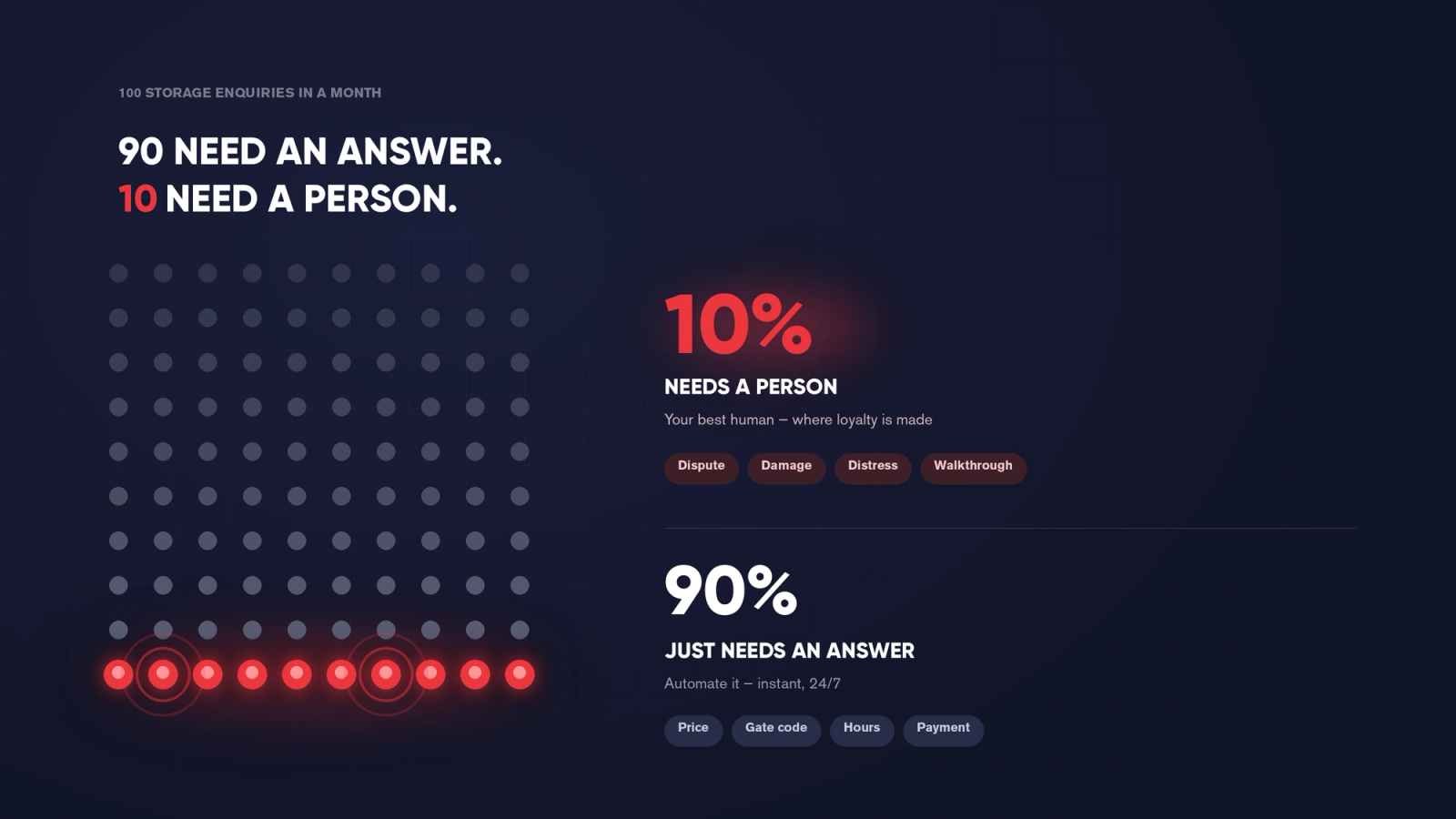
That's a small share of your total contacts. Most weeks, well under one in ten. But it's where loyalty gets made or lost, where reviews get written, and where a tenant decides whether to mention you to a friend. These moments need a capable human with time and authority to actually fix things - not someone drowning in price quotes.
The real mistake
The mistake isn't automating too much, and it isn't automating too little. It's spending your people in the wrong place: staffing the steps customers want instant, then coming up short in the moments they want a human.
Picture the typical front desk. Your best person spends their day reading out prices, taking card numbers, and resending gate codes - work a machine does better - and when the genuinely upset tenant walks in, that person is on the phone quoting unit sizes. You've paid for the human touch and delivered it to nobody.
Automation done right doesn't remove the human. It buys your people back, then lets you spend them where they change the outcome.
Count it this month
One exercise. Take a month of enquiries and contacts - calls, emails, chats, walk-ins - and sort them into two piles: needed a person, or just needed an answer.
Most operators who do this find the "just needed an answer" pile is enormous, and the "needed a person" pile is small but heavy. Quotes, prices, opening hours, gate codes, payment confirmations - answers. Disputes, damage, distress, the walkthrough - people.
Then staff the first pile with automation and the second pile with your best humans. Give the humans time and authority to resolve things properly, because the entire point of automating the easy 90% is doing the hard 10% better than anyone else in your market.
Your customers do want a human connection. Just not when they're asking what a 10 square metre unit costs at ten o'clock at night. Answer that one instantly - and save your people for the day the unit floods.
← Back to the blog