Google Ads works for self-storage. It also burns through budget faster than almost any other channel if you don't know what you're doing. Most operators sit somewhere in the middle: getting some results, quietly suspecting they're overpaying, and not sure where to look.
The problem starts with the conversion
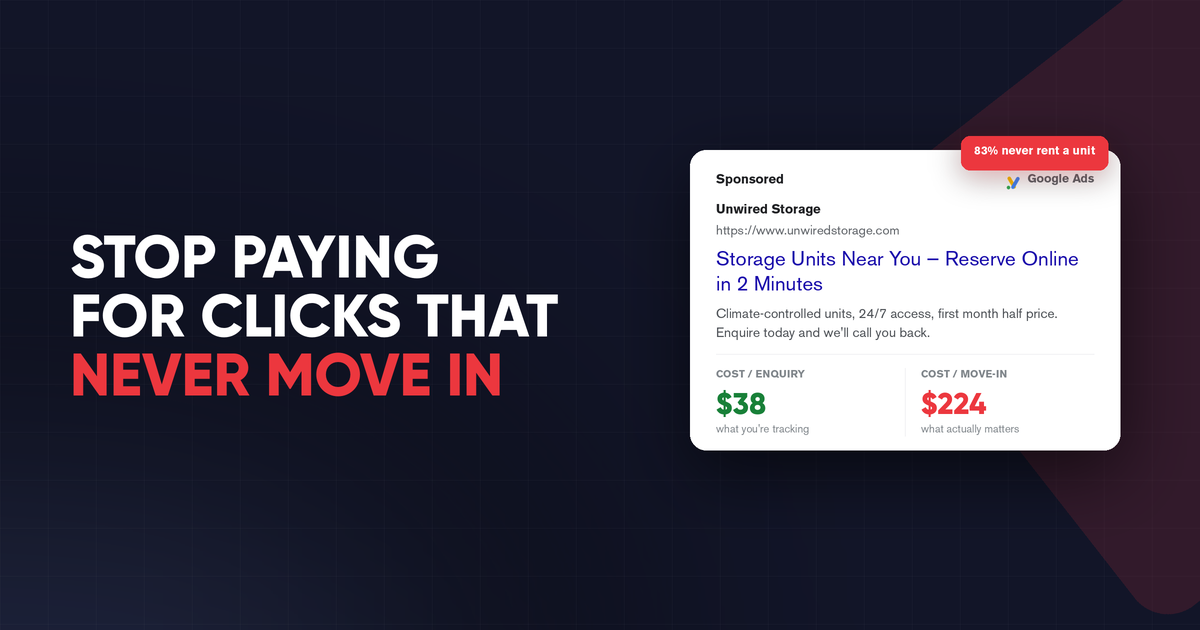
Most operators track a phone call or a form fill as a conversion. That's not a conversion. That's an enquiry. The conversion is a move-in.
When your account is optimised toward enquiries instead of move-ins, you pay for a lot of contacts who never rent a unit. Worse, the algorithm keeps finding more of them, because that's exactly what you told it to chase.
The fix is connecting your PMS data to your ad account so it's feeding on real move-in signals. This isn't complicated to set up. Most operators haven't done it because nobody told them it mattered.
Branded vs. non-branded spend
Split your campaigns and look at cost per move-in separately for branded terms (people searching for your facility by name) and non-branded terms (people searching for "self-storage near me").
Branded cost per move-in is almost always far lower. You're mostly paying for clicks from people who already knew you and were going to contact you anyway.
That doesn't make branded spend wrong. Competitors can bid on your name, and sometimes you need to defend it. But if your non-branded campaigns are performing badly while your blended numbers look fine, branded is masking the problem.
Where the budget actually goes
Check your search terms report. The queries your ads are showing for are often surprising, and not in a good way. "Self-storage jobs near me." "Self-storage franchise." "Free storage units." You're paying for every one of those unless you've built out a proper negative keyword list.
Most operators set up campaigns once and leave them. Negative keywords need ongoing work. Match types need checking. The algorithm will find efficient traffic eventually, but it'll spend a lot of your money experimenting first unless you're actively steering it.
What good looks like
A well-run Google Ads account for a storage operator tracks cost per actual move-in, not cost per click and not cost per lead. Campaigns are cleanly segmented. The negative keyword list is maintained. Conversion data is wired to the PMS. Someone reviews the account at least monthly.
The operators who get real efficiency from Google Ads are almost always the ones who treated it as an operational system rather than a set-and-forget channel. Same logic as everything else in this business: put a process around it and it works. Leave it running on autopilot and it'll drain the account.
Common questions
Most accounts track a phone call or form fill as a conversion. That's an enquiry, not a move-in. When the account optimises toward enquiries, the algorithm keeps finding more people who contact you but never rent. Connect your PMS data to your ad account so it optimises on real move-in signals.
Branded terms are people searching for your facility by name. Non-branded terms are searches like "self-storage near me." Branded cost per move-in is almost always far lower, because those people already knew you. Split the campaigns so branded numbers don't mask weak non-branded performance.
Cost per actual move-in, not cost per click or cost per lead. Cost per click and cost per lead tell you about interest. Only cost per move-in tells you what you're paying to fill a unit.
Check your search terms report. Storage ads often show for queries like "self-storage jobs near me," "self-storage franchise," or "free storage units." You pay for every one of those without a maintained negative keyword list. Negatives need ongoing work, not a one-time setup.
No. Set-and-forget is where most budget drains. Well-run accounts segment campaigns cleanly, wire conversion data to the PMS, maintain negative keywords, and get reviewed at least monthly.