Ask a storage operator for three numbers - occupancy by unit size, enquiry-to-move-in conversion rate, and average response time - and watch what happens. The answer almost always involves three logins, a spreadsheet someone updates when they remember, and at least one "I'd have to check with Sarah."
That's running blind. I operated self-storage for 13 years and I've spent 24 in this industry, and the pattern barely changes by country: the operator works hard, the facility runs fine day to day, and nobody can see the business clearly enough to steer it.
Monthly reporting is archaeology
The deeper problem isn't which numbers you look at. It's WHEN you see them.
The standard rhythm goes like this: the month closes, someone assembles a report, and around the second week of the following month the owner reads about April. By then you're halfway through May, making the same mistakes April was trying to warn you about. If enquiries fell off a cliff on April 3rd because a competitor dropped prices, you've now run six weeks of weak intake before the report even reaches you.
That's not reporting. That's archaeology - digging up artifacts and reconstructing what must have happened to a business that no longer exists.
The dirty secret is that the delay isn't a technology limit. The data was sitting there the whole time. It's a habit inherited from an era of paper ledgers, and most operators have never questioned it.
The data exists. It's just scattered.
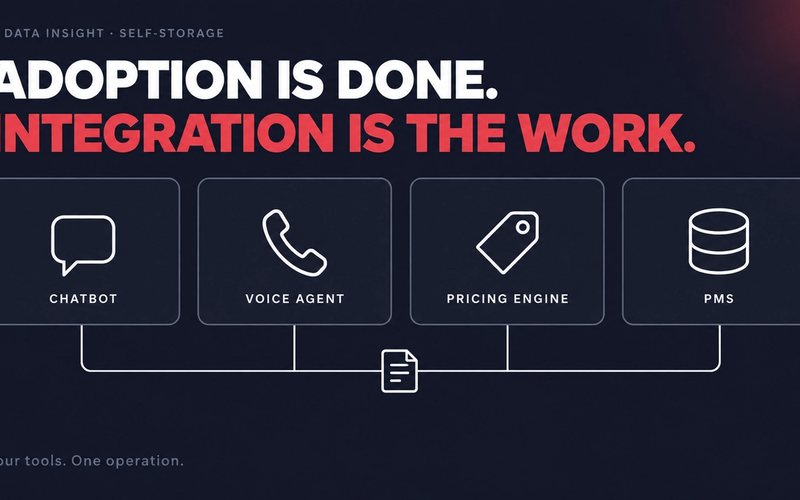
Here's the actual inventory at a typical operation. The PMS knows occupancy, move-ins, move-outs, and arrears. The payment processor knows what cleared and what bounced. Google Analytics knows who visited the website and from where. The ads account knows what you spent. The phone system knows who called and whether anyone picked up. Email and WhatsApp know the enquiries - assuming they didn't land on the manager's personal phone.
Every number an operator needs exists somewhere in that list. None of them can answer a question together. "Which campaigns produced last month's move-ins?" touches four of those systems, so in practice nobody asks it.
So the spreadsheet appears. Someone exports from each system, pastes, fixes the formulas, and produces a number that's out of date before it's finished. The spreadsheet isn't the problem - it's the symptom. It's what a business builds when its systems don't talk.
The fix is unglamorous
Pull everything into one place and refresh it daily. That's the whole strategy.
In practice that means a data warehouse - which sounds enterprise but no longer is - and one dashboard on top. Power BI, Zoho Analytics, take your pick. The tool matters far less than the decision to centralize. Each system pushes or gets pulled into the warehouse overnight, and the dashboard reads from there. No human pastes anything.
The build is measured in weeks, not quarters, because storage isn't a complicated data business. A handful of systems, a few thousand customers, maybe a few sites. This is small data. The hard part was never technical - it's that nobody made it someone's job.
The morning screen
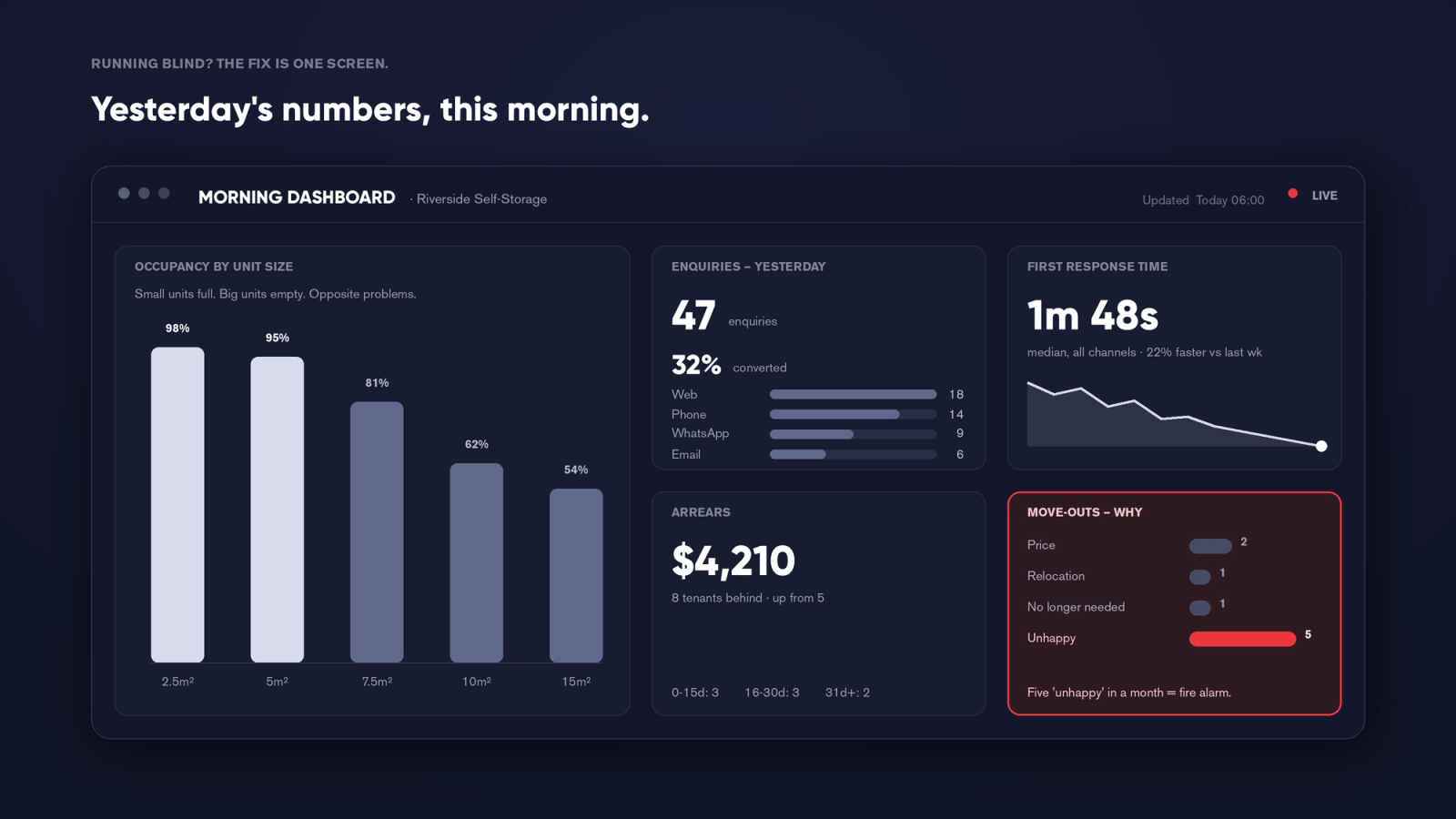
What should be on the dashboard? Here's the screen I'd want every morning as an operator, before the first coffee is finished:
Occupancy by unit size - not blended. Blended occupancy hides that your 5 square metre units are full with a waiting list while the big units sit empty. Those are opposite problems with opposite fixes, and one number averages them into "fine."
Yesterday's enquiries and conversions, by channel. Volume tells you if marketing works. Conversion tells you if the follow-up works. You need both, daily, because a broken phone line or a dead web form should be discovered in one day, not one month.
Response time. How long an enquiry waits before a human or a system answers it. In a distress purchase, this number quietly decides your conversion rate.
Arrears. Who's behind, how far, and trending which way. Arrears caught at day 5 is a phone call. Arrears discovered at day 40 is a lien process.
Move-outs, and why. Every move-out gets a reason. Price, relocation, no longer needed, unhappy. One angry move-out is noise. Five "unhappy" in a month is a fire alarm - if anyone's collecting the reasons.
Nothing on that list is exotic. Every line is a question an owner would ask anyway - the dashboard just answers before they ask.
Clean data comes before AI
A sequencing point most operators currently have backwards.
Everyone's getting pitched AI right now - AI pricing, AI agents, AI forecasting. Some of it's real. But AI on top of scattered, dirty data is expensive noise. If your systems disagree about basic facts, an AI doesn't fix that - it confidently amplifies it. The model is only ever as good as the ground you stand it on.
Which means the unglamorous warehouse-and-dashboard work isn't a competing priority with AI. It's the prerequisite. Operators who centralize their data this year are the ones whose AI projects will actually work next year. The ones who skip ahead will pay twice - once for the AI, and once for the data cleanup they should have done first.
The test
One question tells you which side of this you're on: can you see yesterday's numbers this morning?
Not last month's. Not after asking someone. Yesterday's enquiries, conversions, response times, arrears, and move-outs, on one screen, today.
If yes - you're ahead of most of this industry, and you should be thinking about what to automate next. If no, you're running blind, and every week of delay is another week of decisions made on artifacts. Start the warehouse. It's weeks of unglamorous work that pays you back every single morning after.
← Back to the blog