
The Campaign That Looks Great on Paper
How do we measure the success of a Google or Meta ad campaign? Most business owners look at clicks, leads, and cost per lead or cost per click. A campaign that generates many clicks at a low cost sounds like the ultimate end-goal. But these metrics do not capture what happens after the initial inquiry. A potential tenant submits an inquiry form or a request for a quote, but do they actually sign the lease?
These metrics are popular because they are easy to calculate and easy to understand. They are front and centre on the dashboard of the ads manager. They are not bad KPIs. They just lack the sophistication to show whether the campaign is the best campaign or the best growth driver for your business. They measure their own performance, not necessarily the quality of the leads they generate. Assume this scenario: a Google Ads campaign for a self-storage unit with the goal of filling out a booking inquiry form. The dashboard shows:
| Clicks | Cost | Conversions | Cost/Conversion | ROAS | Top Rank Lost | |
|---|---|---|---|---|---|---|
| Campaign A | 880 | 177 | 90 | 2 | 1135% | 19% |
| Campaign B | 103 | 45 | 6 | 7.5 | 750% | 15% |
Looking strictly at a dashboard like this, Campaign A is a powerhouse: 15 times more conversions, cheaper per conversion, and ROAS is higher. Considering that it loses 19% of the available market share because it runs out of budget, a business owner might be tempted to increase the budget to capture that potential.
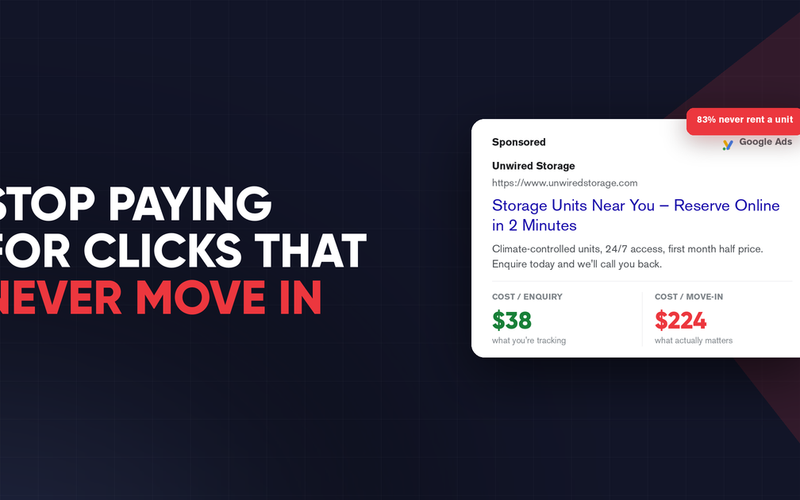
But digging deeper, we see that of those 90 inquiries, only 15 people actually sign the lease, because the campaign is bidding on cheap, broad keywords and targeting customers with low intent. Meanwhile, out of the 6 conversions from Campaign B, every single one resulted in a lease. Suddenly, the true cost of acquisition for Campaign A comes out at 11.8, not 2. Increasing its budget would not translate into more sales.
This is not a platform error. But it is important to remember not to optimise for the wrong metrics.
The Missing Half of the Customer Journey
The reason for this apparent blind spot is that Google and Meta optimize for what they can physically measure. The tracking loop ends at the "Thank You" page.
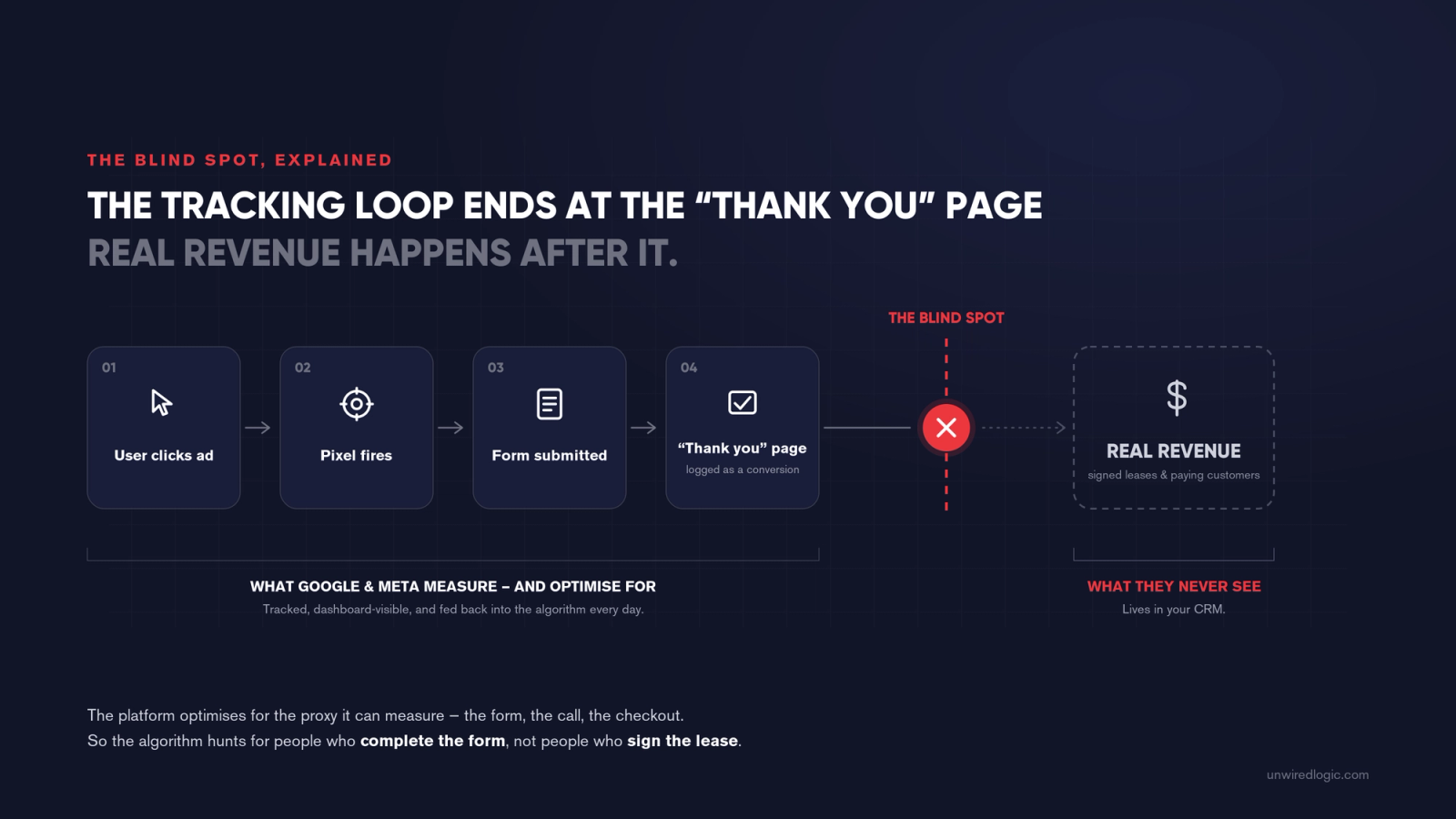
But a phone call does not equate a booking, a form submission does not mean a new customer, and cancellations cannot even be measured. These campaigns track a proxy of success - the phone call, the form, the check-out button - and as a result, they optimise for it. The AI algorithm is looking for the path of least resistance. To put it bluntly: if a booking inquiry form is the goal, it will find customers who like to fill out the form, even if they have low intent to purchase and are not the target customer.
While there are ways to steer the algorithm with negative keywords, customer match lists, better segmentation, etc, at the end of the day, the campaign is tracking and optimizing for a proxy.
Of course, the sales and cancellations are captured by the CRM system, and no good business manager would rely solely on Google or Meta analytics for performance data. But because the sources are disconnected, the whole situation becomes muddy and opaque. Meta has data, Google has data, the CRM system has data, but they sit in silos. Add to this a multi-channel marketing strategy, where each source claims attribution, and it becomes nearly impossible to understand which campaign led to the new customer, how much it really cost, and how much of the budget is wasted on cold leads.
The Attribution Iceberg Beneath the Surface
"Attribution is dead" is a sentence you hear more and more marketeers say. Platform-reported conversions systematically misreport the lead volume they generate.
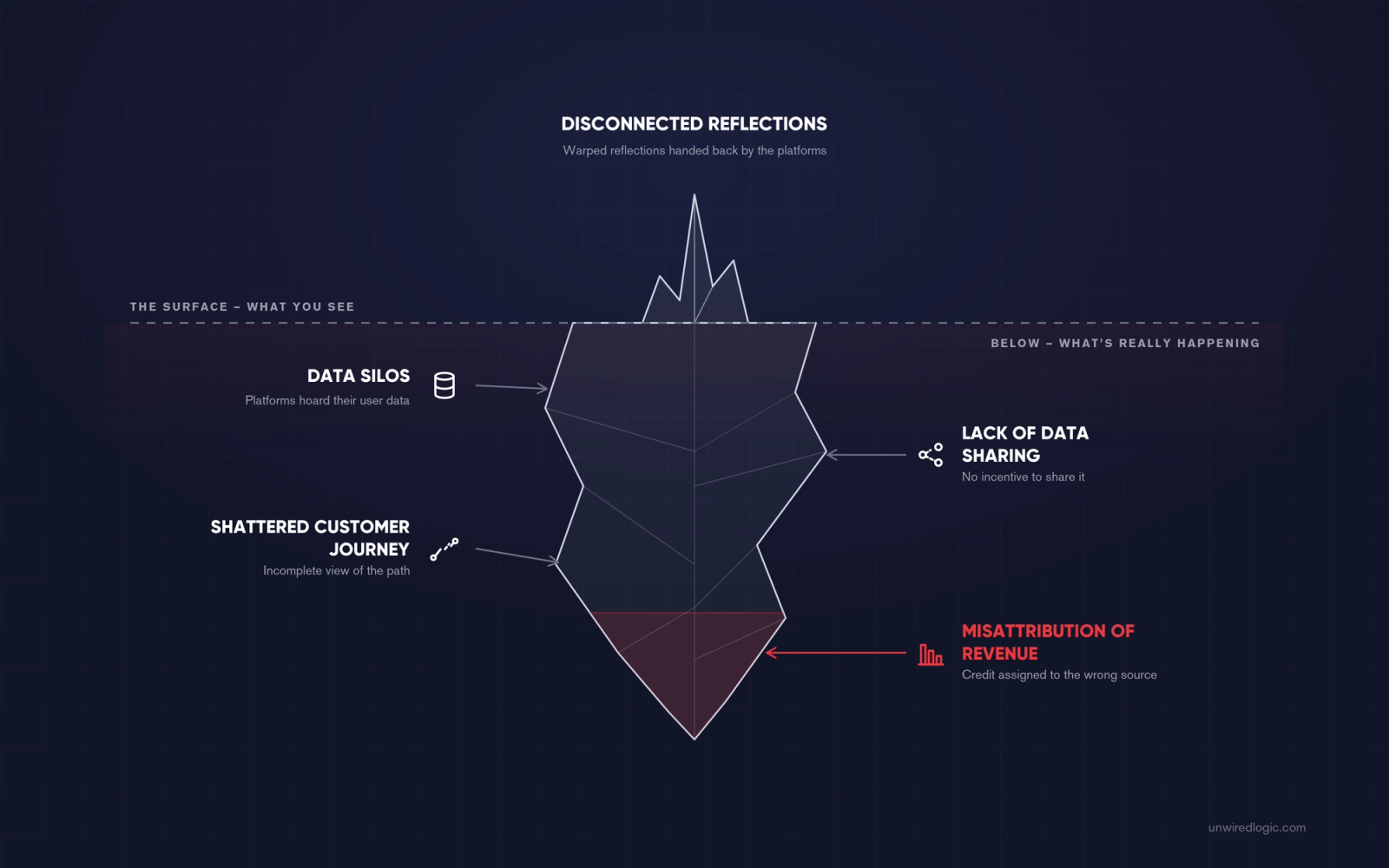
On the surface, it can seem like a technical issue. Conversion tracking that is not set up correctly, a redirect that deletes UTM parameters, or a check-out process that lands on a thank-you page that is not being tracked. But there is more going on here, below the proverbial waves.
The internet is not as open as we often think. Rather, it is a collection of gated communities. Each platform has an immense amount of data on customers and visitors, but there is no incentive whatsoever to share this data. When a customer watches a video ad on Instagram and later searches and buys on Google, the conversion is attributed to the latter. Cross-platform attribution does exist, but it has blind spots. There is also the "Me First" bias. Platforms are incentivised to claim credit for every cent of revenue. Even if a customer scrolls past a retargeting ad without paying it much attention but later completes the check-out, this conversion will end up attributed. This means the same conversion can end up as a success twice, in the analytics dashboards of two different platforms.
But the iceberg goes deeper still. Privacy and data protection are big factors. It started as far back as 2017, when browsers started restricting third-party cookies. Then iOS 14.6 introduced App Tracking Transparency in early 2021, requiring customers to actively opt in, which few did. Studies show that opt-in rates hover around 25% globally. These technical restrictions are compounded by legal and policy restrictions. GDPR in Europe and many similar data privacy laws worldwide require explicit consent and strictly limit the type of data that can be collected, processed, and forwarded. And as if these hurdles were not enough, there remains the prevalent use of ad-blockers by tech-savvy and privacy-conscious consumers.
And then we get to cross-device tracking. A customer watches an ad on YouTube on their smartphone, later sees the same product on their tablet on Instagram, and finally buys it 2 days later on their PC after a Google search - who gets the attribution? Google Ads. Meta, meanwhile, shows a click without conversion.
As a business, you get a series of disconnected and biased customer journeys that you have to stitch together while trying to cut out the overlaps. Because of this, you are feeding the Google and Meta ads algorithms incomplete information - essentially training their AI, which will make thousands of adjustments to your campaigns every single day, on incorrect data, and compounding the issue. Misleading attribution will not present itself as a broken dashboard. Instead, it will be a puzzling mess of incoherent numbers and KPIs that don't match.
The Silent Tax on Your Ad Spend
It is all fine and well to claim that attribution is broken, but what does it mean to the bottom line? This is a very valid point, so let's talk numbers.
If a channel costs 5,000 monthly to generate clicks, but these clicks are low quality and don't result in sales, that is 60,000 per year of budget that could have gone into channels that actually convert.
Across many accounts, it is common to find that 25-40% of spend is misallocated when measured against actual revenue outcomes. So, for a campaign with a 5,000 monthly budget and an attribution waste rate of 30%, fixing it recovers 1,500 every month and 18,000 every year without needing to expand the top-line budget.
Without fixing this leakage, business owners find themselves in a vicious cycle of scaling low-yield campaigns that target low-value customers, which generate more biased data, which trains the algorithm to target low-value customers even more. As the monthly ad budget grows, the cost of acquisition grows silently and unnoticed.
Beyond the financial waste and the data waste, there is operational waste. Facility managers have to burn time chasing down cold leads and unverified phone inquiries. There is no default lead quality scoring in the algorithms Google and Meta use. Remember, they are looking for the path of least resistance, and that unfortunately leaves businesses with a high volume of clicks but a low volume of paying customers.
Closing the Loop: Connecting Marketing to Real Business Outcomes
At this point, you might justifiably ask yourself: "So how does one fix attribution?"
The solution does not require restructuring internal systems, nor a big IT project. Even just switching from browser tracking to server-side tracking will improve the quality of attribution data because it can bypass cookie policy limitations and cross-device attribution issues. But even server-side tracking stops at the website. True attribution will only happen when you connect to the PMS, your source of truth.
The first step is to connect the property management system or the CRM ledger. When a sale actually happens, when a customer signs the lease and moves in, then it is counted as a successful conversion. This information can be synced with the Google and Meta ads platforms. Instead of just tracking conversions, you will be feeding back accurate signals. This clean revenue data will help the automated bidding engines and AI algorithms on those platforms optimise the strategy and target customers. Instead of going the path of least resistance and finding cheap but low-intent leads, campaigns will produce more rent-paying customers.
Solutions like this already exist on the market, and they are native to platforms like Zendesk or Storeganise. Or, to answer the question from the start of this section: to fix attribution, we must close the feedback loop. Stop tracking calls and filled forms, and instead redefine a successful conversion as a completed move-in.
A common objection from business owners when it comes to tracking infrastructure is compliance under frameworks like GDPR or CPRA. In reality, moving away from a browser pixel improves data security and is one of the safest ways to comply with data privacy laws. When feeding the data back into the system, it is stripped of all personally identifiable information and transmitted as a hashed string. Google and Meta can still use the signals to improve the bidding strategy, while the company maintains customer trust and avoids regulatory risks.
Making Existing Ad Spend Work Harder
Implementing such a closed-loop attribution architecture is not another line item in the marketing budget or an additional cost. It is a recovery tool for the existing marketing stack.
Our experience shows that about 25-40% of the monthly ad budget is wasted due to improper attribution. If your business spends 10,000 a month on digital advertising, fixing this leaky plumbing recovers 2,500-4,000 every single month, without needing to change anything about the budget. Recovering even a slice of that wasted advertising budget often pays for the software tool several times over. In other words, it turns a sunk cost of sorts into an investment.
Many owners and CFOs tend to view Google and Meta ads as an unpredictable casino gamble. This is understandable to some degree; the platforms have a steep learning curve. But when you feed back signals and improve the bidding, you transform marketing from speculation into a predictable tool for scaling your business. You can track and mathematically verify every dollar invested in a campaign and link it to paying customers.
Finding a Solution That Fits Your Business
Avoid getting bogged down in overly technical software documentation when closing your conversion loop. Here is a practical checklist to evaluate the right approach:
- Real Outcome Focus: Does the solution track down the money-making transaction (signed lease, sale, move-in), or does it just stop at a "thank-you" page, submitted form, or a call?
- Infrastructure Native: Does it plug directly into your existing infrastructure (e.g. your PMS, CRM, etc.) without requiring a massive, months-long custom engineering project? Many solutions are native to systems like Zendesk and Storeganise.
- Predictable Pricing Model: Platforms that charge a percentage of your ad spend or total revenue effectively penalize your business for growing.
- Fully Managed Setup: Budget owners do not have the time to become data engineers or integration specialists. The ideal partner shouldn't just hand you an API key. They should provide a complete package: a managed setup that handles the heavy lifting for you and ensures a clean data flow from day one.
Ready to Close the Loop?
To sum up, here is how a conversion API like our Google and Meta ads attribution for self-storage operators can benefit your business.
| Feature | Standard Server-Side Tracking | Unwired Logic UTM + Conversion API |
|---|---|---|
| Data Source | Web Server (Website interactions) | PMS / CRM Ledger |
| Conversion Event | Form Fill / Digital Reservation / Call | Physical Move-In / Signed Lease |
| Bidding Focus | Volume of digital hand-raisers | Volume of paying tenants occupying units |
| Setup Overhead | Requires hiring specialized web developers | Fully managed by an experienced local team |
Do you want to find out what your advertising is really producing?
In 25 years of running self-storage operations and helping other businesses manage their self-storage better, we have walked the learning curve. You can benefit from our operational expertise and technical know-how to increase signed leases, not "conversion events". Talk to us and find out what your ad spend is currently doing versus what it could be doing.
← Back to the blog