
Unwired Logic: Tell us about yourself and your company. How did you end up specialising in paid search?
Lucy McNeile, YBA: Sure. I am Lucy McNeile, currently the head of PPC at YBA, and we work with a lot of storage operators to run their paid search as well as Google Business Profiles. Basically, we help storage operators be more visible across Google as a whole and generate more leads and customers off the back of the activity that we run. I got into paid search straight out of university. I joined a large advertising agency and honed in on paid search through that experience. I have now been working in the industry for about eight or nine years, and with YBA for the last two years.
Unwired Logic: You’ve worked across a lot of industries. What made self-storage stick out? What’s genuinely different about marketing a storage facility versus, say, a law firm or an e-commerce shop?
Lucy McNeile, YBA: We started working with storage operators through our managing director, Laura, who was involved with the Self-Storage Association and saw an opportunity to help operators get visibility across Google.
The key differences for storage as an industry are, first, that it tends to be very locally focused. Most customers for storage operators come from within about a five- to ten-mile radius of the actual storage site, and that is quite different to national companies or e-commerce, which can sell nationally or internationally. Their target audience is a lot broader than you tend to see across storage operators, where it is hyper-local and very focused on a specific audience.
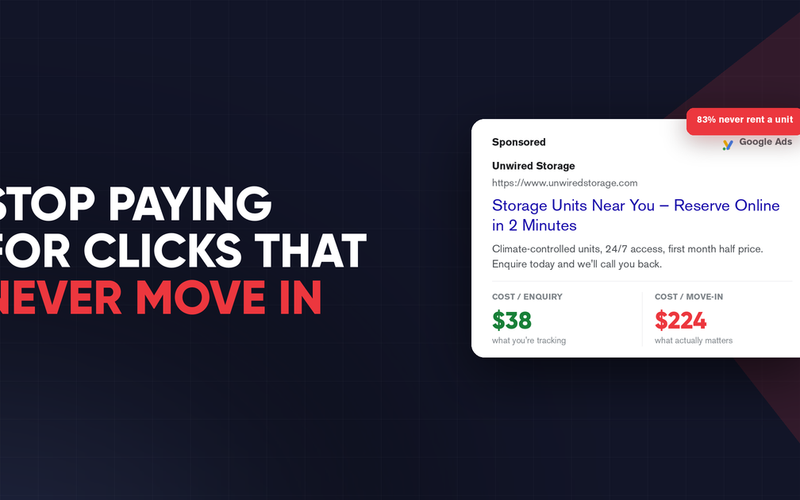
The other difference is that it is predominantly lead generation, versus e-commerce businesses, which are more sales-focused and revenue-focused. That feeds into what Unwired Logic has produced, which is linking a lead all the way through to the actual customer and tracking that value to use it within the advertising. At the moment, a lot of the conversions and things that are tracked tend to be more lead-focused or early interactions with storage companies, rather than a simple e-commerce journey where someone goes onto the website, looks at the product, buys it, and it is very simple to track. With storage, it is a lot more complicated in terms of the user, the way people interact, the company following up with the customers, and then actually converting them into customers.
Unwired Logic: Storage operators sometimes say they can never see which enquiries come from Google Ads. For an operator who’s never thought about it, what exactly are they blind to, and what is that blindness costing them?
Lucy McNeile, YBA: What it is costing them is that if they are putting investment into ads, they are not getting the most out of their investment that they could. They may still be generating traffic, and depending on how the account is set up, it may or may not be relevant traffic. Unless that is tracked and fed back into the advertising platform, it cannot really be used to optimize what is running and get the most out of the investment.
There is not a specific number to it in terms of wastage, but the ultimate goal would be to track that whole user journey and feed it back into the platform. What tends to happen if you do that is the conversion rates will be higher. Google suggests you will get a 14% higher conversion rate if you are running on conversion value bidding versus just conversion volume. It does make a difference in the metrics you will be seeing and reporting on, and it is something we have seen through testing as well. You get stronger results through being able to see that whole journey and feed it back in.
Unwired Logic: “Self storage near me”. How much of a storage operator’s budget should be defending that local intent?
Lucy McNeile, YBA: There is no one-size-fits-all when it comes to storage advertising. It will always be different depending on what the operator’s goals are, what the location is like, what the competition is like. There are a lot of factors that will play into how to best use that budget.
When it comes to the local-focused keywords, I would say they are generally the most important for storage operators, so being visible across those is very important. But you have to fit that with whatever their specific goals are for the business.
If there is an operator that is at 90% capacity in terms of their storage site, their account should look very different to someone who has opened a new storage site and is looking to get customers in and grow. I would expect the visibility of that newer site to be a lot more aggressive, with a lot higher coverage, versus the site that is near full capacity.
The strategy does need to change and is very dependent on the individual storage site and operator, what the goals are, and what the outcome is. But those very specific local keywords do tend to be the key ones to get visibility across for storage operators, because it is very locally focused and those are the searches people will be looking at when they are looking for storage operators. If you are not bidding on those keywords and your competitors are, they are going to be taking the chunk of that traffic and converting those customers where you are not being seen or even looked at as a potential option.
Unwired Logic: An operator has one site sitting at 75% occupancy and £1000 a month for ads. Where does that first pound go, and why?
Lucy McNeile, YBA: It would partly depend on what the competition looks like locally, how many competitors are bidding in the auctions, and how competitive they are going to need to be, because a lot of that budget will be dependent on what the CPCs are. If there is a lot of competition, the cost per click is going to be a lot higher, and that budget is not going to go as far as you might imagine.
The first step would be to review what local competition looks like and what the average CPCs are across the key keywords you would be looking to cover. Then you would be able to plan what would be doable within a £1000 budget for that local area.
The majority of it would probably go on locally focused keywords within a campaign, probably in exact match and phrase match forms because they are going to be more relevant than using broader formats. It may depend on what the average cost will look like and whether it is going to generate enough traffic and inquiries to keep that capacity increasing and then maintaining it, because there will be some level of churn when it comes to the storage site as well.
Unwired Logic: Where do storage operators waste the most money in Google Ads right now?
Lucy McNeile, YBA: It depends on the scenario, but for some multi-site storage operators, a lot of the wastage is from not having a targeted strategy per individual site. They might go for the same keyword and campaign coverage across all of their sites, but they are not really taking into account how much of a priority that individual site is within their strategy.
For single sites, the biggest wastage tends to be on irrelevant search queries and not having the correct negative keywords in place to automatically block irrelevant traffic. People often do not look in enough detail at what traffic is actually being picked up.
With storage, we often see searches for things like cloud storage or internal home storage being picked up because they are closely connected, but they are not actually relevant for that individual business. Things like that, that people do not necessarily think through before launching, tend to be where spend gets wasted. If you are not picking it up and keeping a close eye on it, it will be a continuous loss longer term as well.
Unwired Logic: What’s a piece of common digital marketing advice for storage that you think is simply wrong?
Lucy McNeile, YBA: One thing that is cropping up a lot at the moment is people saying that no one uses Google anymore and everyone only uses AI chat functions like ChatGPT, Claude, or Gemini. It is just not true. It is obviously a growing area and one that should be monitored and watched, but to say that no one uses Google anymore is a massive overstatement.
We see a lot of impressions and a lot of traffic still coming through all of the search terms and ads we run across Google. It is just not the case. Particularly for small operators, Google is still the number one platform where marketing budget should be invested, because it is a huge missed opportunity for a lot of people.
A lot of operators ask whether they should run ChatGPT ads or try to get more visibility on those platforms. From an organic perspective, they absolutely should, but if you are looking at where to invest actual marketing budget, the recommendation would still be for Google, where there is still visibility to be gained, rather than newer platforms where it is a lot more uncertain what those formats look like and what they are actually going to deliver.
Unwired Logic: The big branded chains have huge budgets and look untouchable on Google. What can an independent, single-site operator do on paid search to get an edge?
Lucy McNeile, YBA: It is not necessarily how much budget you have. It is how you utilize that budget that matters most. There will be huge budgets for multi-site storage operators, some of which will be wasted in the way things are set up. Smaller operators can compete by having a really strong paid strategy. That could mean hyper-specific location targeting, or very small coverage of keywords, but only the highest-performing keywords in terms of what should be covered.
It also comes down to measurement. Being able to link back the actual customers and revenue from even a small storage site is going to give you more learnings and more options when it comes to how you optimize that budget, even if it is lower. You can invest more of it on people who are actually more likely to convert and turn into customers, rather than using broader conversion goals like clicks on emails or clicks on calls.
It is a multi-phase approach, but it is about the strategy selected rather than just the budget available. We have a lot of customers who start on a lower budget and see the effectiveness of it, then gradually increase their budget because they are seeing results from the smaller budget they started with. That helps them grow the account effectively within the budget allocations.
Unwired Logic: When should a storage operator hand paid search to an agency versus keep it in-house, and what’s the honest point where it’s worth paying for help?
Lucy McNeile, YBA: It is a no-brainer that there are a lot of intricacies with the platform, the campaign types, the management, and the optimization of it. From my perspective, you should engage an expert from the start if you are looking to optimize and use Google Ads as a platform, even if it is just for advice. I think you should definitely consult with them from an advice perspective.
Unwired Logic: Everyone’s talking about AI in ads. Performance Max, automated bidding, AI-written copy. Where does it genuinely help a storage operator, and where is it quietly burning their budget?
Lucy McNeile, YBA: Again, it is very account-by-account dependent. We have done a lot of tests with different formats and different match types, and we see differing results throughout, even within the same industry. Some of the accounts we have got Performance Max running on work well and generate valid inquiries. A lot of it sits within the setup and the measurement of it. The only way it works is if you input the right and most relevant information. If you do, you will get results from it. If you do not, you will not.
If you have the correct settings for a Performance Max campaign, relevant assets, negative keywords in place, exclusions across display networks that are not going to be relevant, location targeting on, location exclusions on, and the right conversion goals you are working towards, those levers are going to make a massive difference.
If you can set up a campaign that uses more automated running such as PMax or AI Max for Search, you need that feedback from a conversion perspective. If you run those formats on conversion value bidding, they are going to be a lot more effective in terms of driving relevant traffic and the likelihood of converting those inquiries into actual customers.
Unwired Logic: If you were handed the marketing for a brand-new storage site opening in six months, what are the first three things you’d do before the doors even open?
Lucy McNeile, YBA: The first one would be the whole location and competitor piece, seeing what the landscape looks like. It can also be very useful from the operator’s perspective to see who the competitors nearby are, what their pricing structure looks like, what their website looks like, and what you are actually going to be compared to from a user perspective.
Then you can feed that into not only your marketing strategy, but also your general plan. If that means making updates to the website so you can compete better or provide a better user experience for people who do come to your website, those changes can be made before you start investing money into marketing and getting people to land on your website.
You also need to look at what the goals are for the company, what their expected lead-to-sale conversion rate would look like, and whether they have any requirements around cost per lead or anything specific like that, so that can feed into the marketing plan.
There is also the messaging side: what the USPs are, whether there are any offerings that should be included, and what it will look like from that perspective. We usually suggest implementing ads four to six weeks in advance of the site opening so inquiries can start being generated straight away and people can be booked in prior to the site opening.
← Back to the blog