Part 3: The blueprint — a reference architecture for self-storage customer operations
Previously:
This is the third piece in our series on customer operations stacks for self-storage. Part 1 made the case that B2B CRM is the wrong foundation and conversation platforms are the right one. Part 2 covered what gets hidden when operators run on the wrong platform — the metrics that aren't built in, the gaming problem, the visibility gap on existing customers.
This piece is the architecture we recommend to multi-site operators evaluating their stack. What sits at the core, what plugs into it, what's native, what isn't, and where the honest gaps are.
The core: a ticketing platform
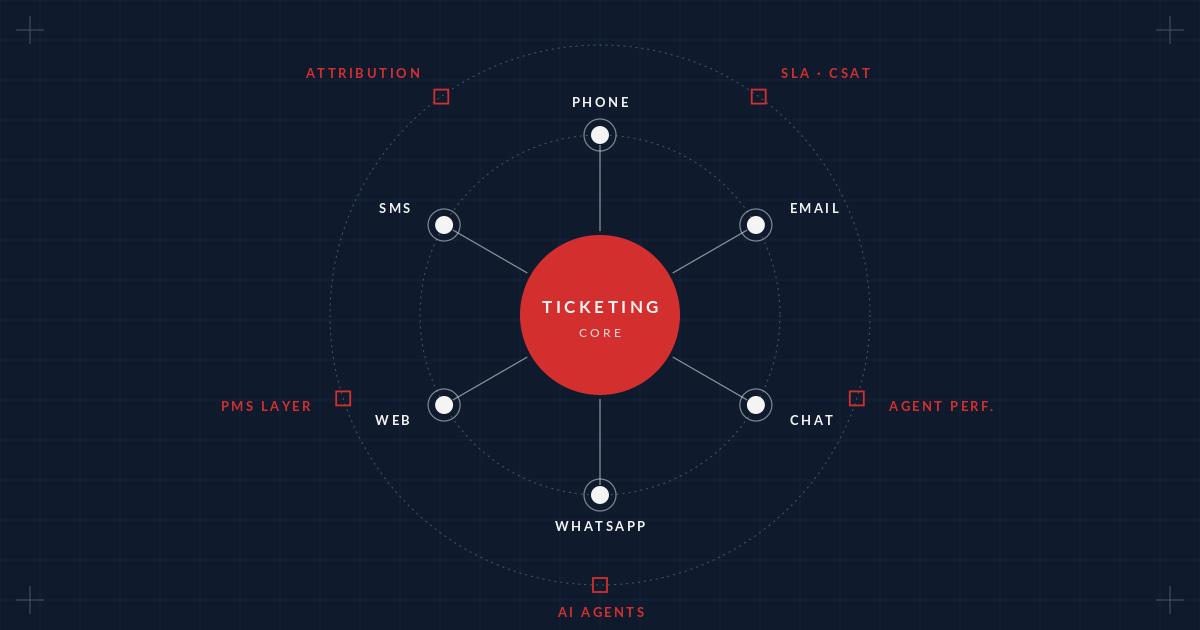
The center of the stack is a ticketing platform — the category of software built around conversation management rather than deal management. Zendesk, Respond.io, and others in that category all work. The specific choice depends on scale, budget, channel mix, and existing tooling — we help clients pick based on their situation, but the category is what matters.
Every customer interaction — new lead, existing tenant, billing question, move-out, complaint — flows into the same queue. Routed appropriately, tracked consistently, measurable across channels and agents.
This is the foundation. Everything else plugs into it.
Omnichannel inbox — native
Phone, email, chat, WhatsApp, web form, SMS. All in one queue, all visible to the agent in a single interface, all measurable as conversation volume by channel.
In a ticketing platform this is native. Plug in the channels you support, set up routing, done.
In a B2B CRM, each channel typically requires a separate integration. Phone needs a connector like Aircall. Chat needs Intercom or similar. WhatsApp needs a third-party integration. Each one is a separate vendor, a separate contract, a separate set of dashboards. The data flows are partial and the agent's interface is fragmented.
The customer's expectation is simple: contact you on whatever channel is convenient, get a fast response. The architecture should reflect that, not fight it.
SLAs and response time tracking — native
First response time, resolution time, SLA compliance by channel, by agent, by ticket type. Configurable thresholds. Alerts when SLAs are at risk.
Native to ticketing platforms. Bolt-on or absent in B2B CRMs.
CSAT and NPS surveys — native
Post-interaction surveys triggered automatically. Response data tied back to the conversation, the agent, and the channel. Trend reporting over time.
Native to ticketing platforms. In B2B CRMs, this is typically a separate survey tool stitched in with integrations.
Agent performance dashboards — native
Conversations handled, average response time, average resolution time, CSAT score, channel mix, escalation rate. Per agent, per team, per site.
Native to ticketing platforms. In B2B CRMs, you can build pieces of this with custom reporting and add-ons, but the data model wasn't designed for service-based performance metrics.
AI agents — native or specialized
Two paths here, both viable.
The platform-native AI agents that come with modern ticketing systems handle a lot of the standard work — first-line responses, FAQ deflection, ticket routing, summarization, draft replies for human agents. These capabilities have matured significantly and for many operators they're sufficient.
The specialized path is to add purpose-built AI agents on top of the ticketing platform — agents trained on self-storage specifically, on the operator's own historical data, on the unit mix and pricing, on the local market. These integrate through standard APIs and handle higher-value tasks like full lead qualification conversations, dynamic pricing discussions, and complex existing-customer service.
Most multi-site operators will end up running both — native AI for the broad work, specialized AI agents for the parts of the business where the operator has a competitive advantage to protect.
Existing customer service — native
This is the capability gap that hurts B2B CRM operators most. As we covered in Parts 1 and 2, 40 to 60 percent of self-storage customer interactions come from existing tenants. Ticketing platforms were built around this kind of work. B2B CRMs were not.
In the reference architecture, new leads and existing customers live in the same system, with appropriate routing, separate SLAs if needed, and unified reporting.
Lead attribution back to ad spend — the honest gap
One area where B2B CRMs have historically had a real advantage: lead attribution back to Google Ads and Meta Ads.
HubSpot in particular has built strong native attribution — tracking which ad clicked, which campaign, which keyword, which landing page, all the way through to conversion and revenue. For operators investing significantly in paid media, this is a legitimate reason they choose HubSpot. Out-of-the-box ticketing platforms don't match it.
What we've done for clients is build the attribution layer on top of the ticketing system. UTM capture from the inbound contact, persisted through the conversation, tied back to the customer record once they convert, with reporting back into the marketing platforms. It's a configuration project, not a product feature, and it requires upfront work the HubSpot path doesn't.
If lead attribution is your single biggest priority and you're not willing to do the configuration work, a B2B CRM may genuinely be the right choice for that specific need. For most multi-site operators we work with, the trade-off is worth it — they get the lead attribution they need and the operational visibility a B2B CRM can't deliver.
PMS integration
The ticketing platform sits alongside the property management system, not instead of it. SiteLink, storEDGE, Storeganise, Kinnovis, Stora, and others all handle the unit inventory, billing, and rental agreement layer. The ticketing platform handles the customer-facing interaction layer.
The integration between them carries customer records, unit information, payment status, and rental history into the ticketing system so agents have the full context when they're working a conversation. Most major PMSs have APIs that support this.
What to ask when you’re evaluating
If you're a multi-site operator looking at a new platform — or reconsidering your current one — the questions to put to vendors:
- Can I see speed-to-lead, first response time, and SLA compliance natively, by channel and by agent?
- Can my agents disqualify inbound leads, or is "qualified" the default for any real contact?
- Can new leads and existing customers live in the same system with unified reporting?
- What's the omnichannel inbox — native, or assembled from third-party integrations?
- How does lead attribution back to Google and Meta work, and what's required to set it up?
- What AI agent capabilities are native, and what's the path to specialized agents on top?
The answers will tell you whether the platform was built for self-storage operations or for a different business that you're being asked to retrofit yourself into.
Across the operators we've worked with — 2,000+ buildings, 200,000+ tenants, two decades — we've seen the same pattern repeatedly: operators running on the wrong foundation, struggling with visibility they can't fix, and assuming the problem is their team or their process.
It's usually the platform.
← Back to the blog