Part 1: The wrong foundation — why B2B CRM is the wrong starting point for self-storage
Most self-storage operators we work with are running their customer-facing operations on a B2B CRM — HubSpot, Pipedrive, and others built for sales teams. Some inherited the choice. Some bought it because the demos were impressive. Some were sold the platform by a consultant who builds for B2B sales teams and assumed self-storage was close enough.
It isn't.
Self-storage isn't a B2B sale. It's inbound demand and subscription revenue. The unit of work is a conversation, not a deal. And the platform you build on shapes everything downstream — what your team can see, what they can measure, what they can improve, and what gets quietly hidden.
This is the first piece in a three-part series on how multi-site operators should be thinking about their customer operations stack. We'll cover the diagnosis here, the visibility gap in Part 2, and the reference architecture in Part 3.
B2B CRMs are built for a different business
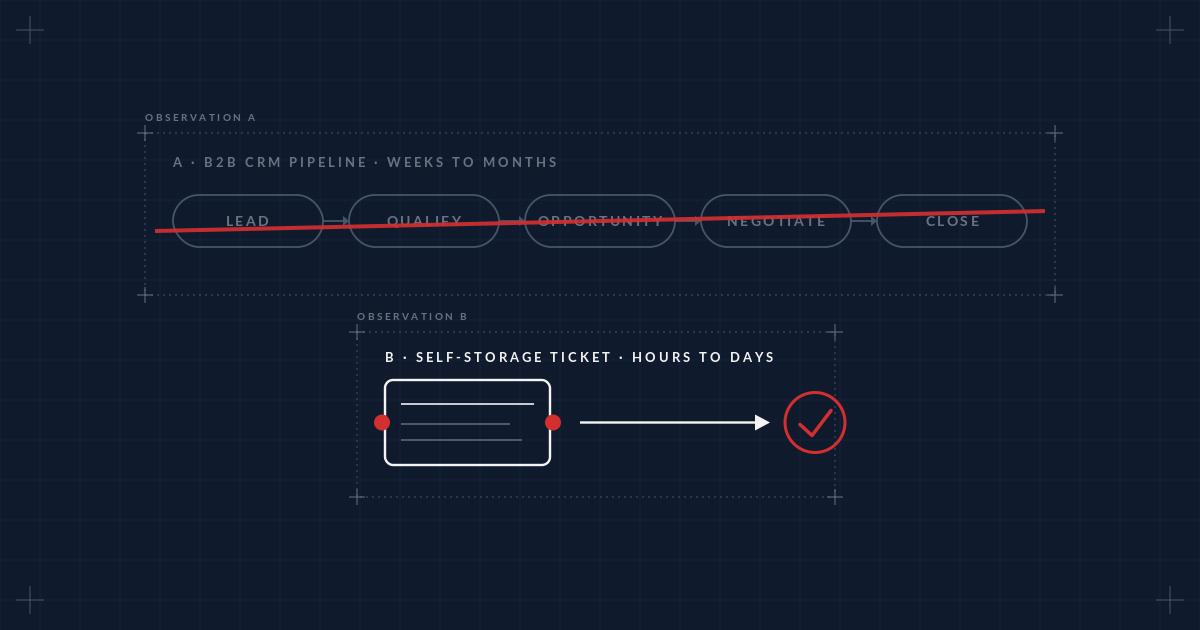
A B2B CRM is built around opportunity management. The model is simple: a lead comes in, an SDR qualifies it, a sales rep converts it to an opportunity, the opportunity moves through a pipeline over weeks or months, and eventually it closes or it doesn't. Forecasting, deal stages, and pipeline reviews are the core of how the system operates. The platform is good at this. It's been refined for two decades for businesses that work this way.
Self-storage doesn't work this way.
A self-storage sales cycle is hours to days. Someone has a life event — a death, a divorce, a move, a downsizing — and they need a unit. They look online, they make contact through whatever channel is easiest, and they expect a fast response. If you respond first and the experience is smooth, you get the rental. If you don't, your competitor does. There is no qualification stage. There is no opportunity to nurture. There is no quarterly forecast call.
The customer's question isn't "should I buy this?" It's "is this the right size, is the price reasonable, and can I sign up now?"
Forcing that interaction through a B2B CRM means stapling a fast, transactional motion onto a platform built for a slow, considered one. It works, in the sense that nothing actively breaks. But it generates friction in places friction shouldn't exist, and the friction shows up in the numbers operators don't realize they're missing.
Inbound demand is qualified by default
In a B2B CRM, qualification is a step. The lead arrives. Someone decides whether the lead is worth pursuing. The lead either becomes an opportunity and gets worked, or it gets marked "not qualified" and dies in a report.
In self-storage, that step is dead weight — and worse than dead weight, because the qualification step creates room for outcomes that hurt the operator without anyone noticing.
If a customer is contacting you about a unit, they're qualified. They have a need, they found you, and they reached out. The only meaningful filtering is between real inquiries and spam. Spam is its own category and management should be able to audit what gets marked there.
We'll go deeper on what happens when "not qualified" stays in the workflow in Part 2. For now: in self-storage, every inbound contact is a qualified lead. The platform should reflect that, not fight it.
Existing customers are 40–60% of the work
Here's the part most operators don't account for when they pick a platform.
Across the operators we've worked with — covering 2,000+ buildings and 200,000+ tenants over two decades — 40 to 60 percent of total customer interactions come from existing tenants. Billing questions. Move-out requests. Lock issues. Payment disputes. Notifications about price increases. Insurance updates. Access problems.
A B2B CRM is built for the sales motion. It's not built for the long tail of subscription customer service that makes up half or more of an operator's actual workload. Operators using B2B CRMs typically end up with one of two patterns: they run existing-customer interactions outside the system entirely — untracked — or they bolt on a separate help desk and try to integrate the two.
Conversation platforms were built for exactly this kind of work. New leads and existing customers live in the same queue, with appropriate routing, SLAs, and visibility. That's not a feature they added later. It's what they were built to do.
Conversations match the actual unit of work
The right foundation for self-storage is the conversation: a single inbound contact — new lead or existing customer — that needs to be acknowledged, worked, and resolved. Some conversations convert into rentals. Some answer a billing question. Some escalate. All of them flow through the same system, with response time, resolution time, channel, agent, and outcome captured automatically.
This is what self-storage operations actually look like:
- Respond fast to inbound, regardless of channel
- Convert the new ones who are ready to rent
- Service the existing ones quickly so they keep paying
- Measure what's happening across all of it
A conversation platform is built for that flow. A B2B CRM is built for a different flow and asks operators to retrofit themselves into it.
What this means if you’re evaluating your stack
If you're a multi-site operator looking at your current setup and sensing something is off — response times you can't explain, lead numbers that don't match what marketing is generating, existing-customer issues falling through gaps, agents whose performance you can't really see — the platform you're building on may be the root cause, not your team.
B2B CRMs are excellent software for the businesses they were designed for. Self-storage isn't one of them.
Part 2 covers what gets hidden when you're running on the wrong foundation — and why the numbers operators report aren't the numbers they're actually running.
← Back to the blog