Your chatbot quoted a rate at 11pm. The pricing engine changed it at midnight. The customer walked in Monday and pointed at their phone. That's the shape of the problem this whole industry is quietly running into.
Ninety percent of European self-storage operators now use AI for pricing or analytics. That figure comes from the 2025 FEDESSA/CBRE European Self-Storage Industry Report, and it marks a quiet turning point. AI has stopped being the thing that sets one operator apart from another.
When nine in ten facilities are running it, adoption isn't an advantage. It's the baseline.
The vendor shelf tells the same story. StoreEase has launched EaseOS, an AI-native platform with voice and web agents built in. Kinnovis runs JaneAI, a chatbot that handles inquiries around the clock in more than ten languages. Storable is embedding AI across its management software. Every operator can now buy a voice agent, a chatbot, a dynamic pricing engine, and an analytics layer off the shelf.
So if everyone has the same tools, where does the gap open up?
The Question That Actually Matters
It isn't whether you use AI. It's whether the AI you use is connected to everything else you run.
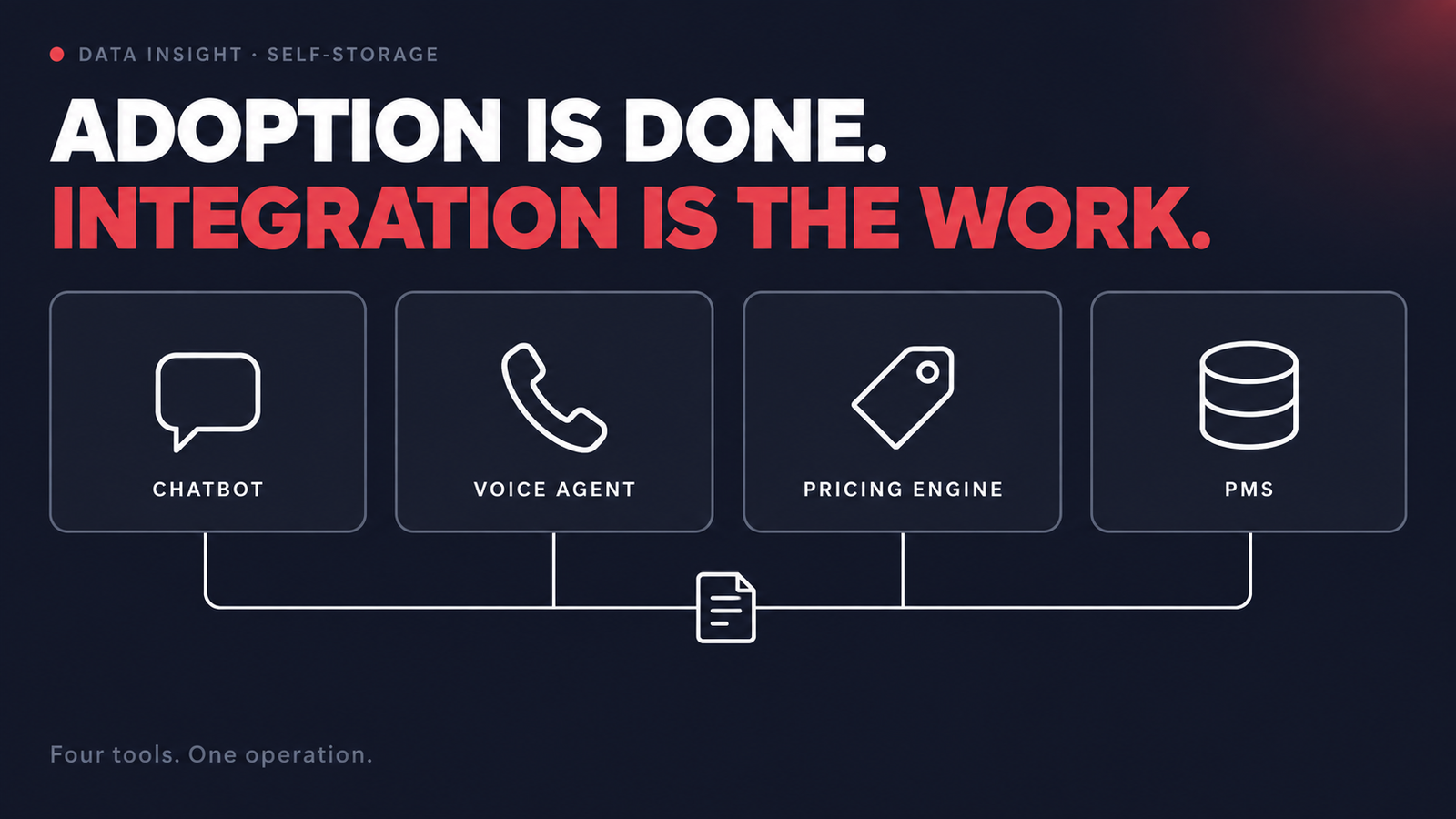
A voice agent, a website chatbot, a pricing engine, and a property management system are four different products. Usually from four different vendors, often bought at four different times. Each one is capable on its own. The question is whether they share a single, live picture of your facility, or whether each works from its own copy of the truth, slightly out of date the moment it's made.
Most operators, when they look closely, find the second thing. They've adopted AI. They haven't integrated it.
Four Signs Your Stack Isn't Talking to Itself
Disconnected systems don't announce themselves. They look fine in a demo and fall apart in the gaps between tools. One operator we worked with lost roughly half a day of counter time in a week to a single sync gap: the voice agent kept booking units the PMS marked available, that had been rented at the counter that morning. Nothing in the reporting caught it. The refunds did. Here's how to spot the same shape without opening a single contract.
1. Your chatbot quotes a price your pricing engine already changed.
Dynamic pricing updates a rate overnight, but the chatbot still pulls yesterday's number from a separate table. A customer gets quoted one price online and a different one at the counter. Both tools are "right." They just aren't reading from the same place.
2. Your voice agent books a unit your PMS shows as occupied.
The agent takes a reservation against availability data that's an hour, a day, or a sync cycle stale. Now two tenants expect the same unit, and a staff member is cleaning up a problem the automation created.
3. A customer repeats themselves every time they switch channels.
They start a web chat, then call, then walk in, and each system treats them as a stranger because none of them shares a customer record. The "AI experience" feels worse than one human with a notepad.
4. You can't trace a lead from first touch to signed lease.
The ad platform knows about the click. The chatbot knows about the inquiry. The PMS knows about the move-in. No single system connects all three, so you can't say which marketing actually filled a unit. You're optimizing spend on a guess.
If two or more of these sound familiar, the issue isn't your AI. It's that your AI is running as three or four disconnected point solutions instead of one connected operation.
Why This Happens to Good Operators
It isn't carelessness. It's how the tools arrived.
AI reached self-storage as a wave of point solutions. A chatbot here, a pricing tool there, a voice agent added when call volume spiked. Each was bought to solve one problem, and each solved it. But buying four good tools is not the same as building one system. Integration is the unglamorous work that rarely makes it onto a feature list, so it quietly becomes nobody's job.
The result is a facility that looks fully AI-enabled on paper and, in practice, runs four smart tools each making confident decisions on a partial view.
What "Integrated" Actually Looks Like
A connected stack isn't a bigger pile of AI. It's the same tools sharing one source of truth.
When the pricing engine changes a rate, the chatbot and the voice agent know immediately. When the voice agent books a unit, the PMS reflects it before the next call comes in. When a lead converts, that move-in flows back to the channel that produced it. The customer record follows the customer across web, phone, and counter, so no one is ever a stranger to your own systems.
The market is starting to catch up. Storeganise launched an AI connector in early 2026 that pipes an operator's live data straight into general-purpose AI tools like ChatGPT and Claude. It's a signal, not a solution: the vendors are saying out loud what operators have been feeling for a year, that the chatbot isn't the point, the shared source of truth is. Owning that connective layer, and deciding what your one source of truth actually is before you pipe AI into it, is still your job.
None of this requires ripping out what you have. The tools are mostly fine. What's usually missing is the connective layer that makes them behave like one operation instead of four, and the discipline to treat that layer as infrastructure.
This week: pick one of the four signs. Audit for it. If you find it, you've found where the leak starts.
Find your leak in five questions
The AI Integration Health Check walks you through the four signs against your own stack. Two minutes, no scoring, no vendor pitch.
Common questions
Using AI means running tools like a chatbot, voice agent, or pricing engine. Integrating AI means those tools share one live source of truth, so a change in one is reflected in all the others. You can use AI without integrating it, and most operators do.
Watch for four signs: your chatbot quotes a price your pricing engine already changed, your voice agent books a unit the PMS shows as occupied, customers repeat themselves when they switch between web, phone, and counter, and you can't trace a lead from first click to signed lease. Two or more of these usually means your tools are running as disconnected point solutions.
Usually not. The tools themselves are mostly fine. What's typically missing is the connective layer that lets them read from one shared, live source of data instead of four separate copies.