Part 2: What you can’t see — the visibility gap in self-storage customer operations
Previously: Part 1 — The wrong foundation.
In Part 1, we made the case that B2B CRM is the wrong foundation for self-storage and conversation platforms are the right one. That's a structural argument about how the platforms are designed.
This piece is about what happens in practice when operators run on the wrong foundation. Specifically: what gets hidden, what gets gamed, and what an operator can't see about their own business until they switch.
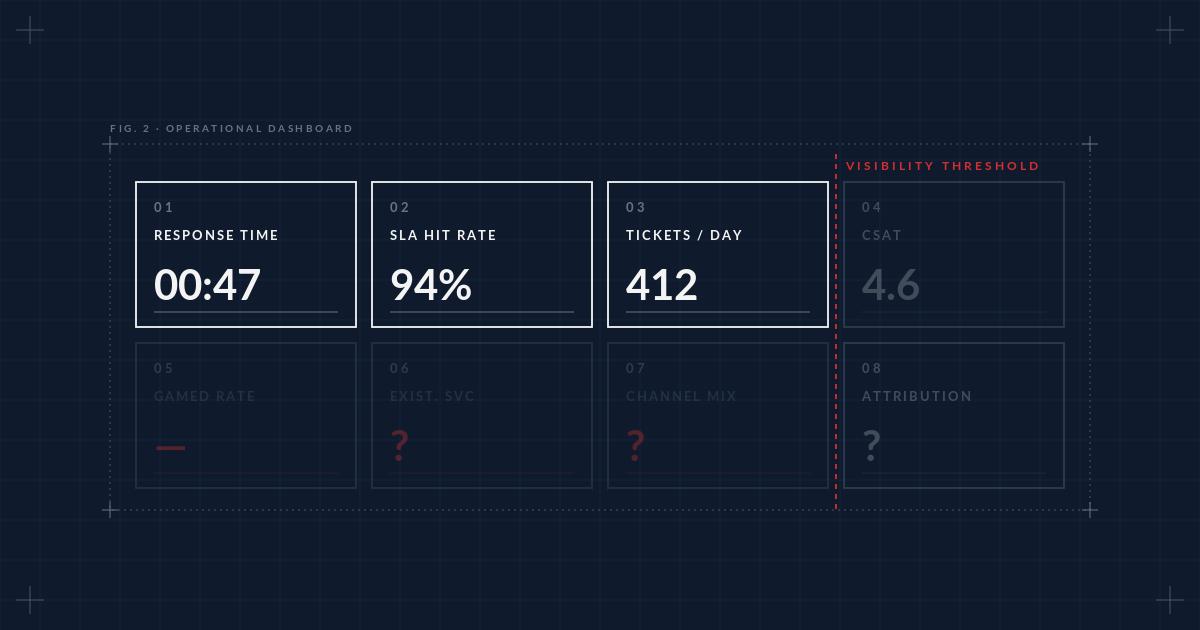
The metrics that matter aren’t built in
Self-storage is a speed and service business. The metrics that determine whether you're winning or losing are operational, not pipeline-based:
- Speed-to-lead — how fast does someone get a real response after they reach out
- First response time across channels
- SLA compliance — are we hitting our internal targets, and where are we missing them
- CSAT — did the customer feel served
- NPS — would they recommend us
- Agent performance — conversations handled, resolution time, channel mix, where individuals are strong and where they're struggling
- Volume by channel — phone, email, chat, WhatsApp, web form, walk-in
- Reason for contact — why are existing customers reaching out, and is that volume changing
In a conversation platform, all of this is native. The platform was built around it. You configure your SLAs, you turn on CSAT surveys, you set up your dashboards, and the data flows.
In a B2B CRM, most of this is bolt-on. Some of it is technically possible with enough configuration and add-on apps. Some of it isn't really possible at all, because the underlying data model wasn't designed for it. Operators end up with partial visibility, inconsistent reporting, and metrics that depend on whether agents remembered to log activities correctly. In a business where the difference between winning and losing a rental is response time, guessing is not a viable strategy.
The gaming problem
Here's what we've watched happen at multiple operators running B2B CRMs.
A lead comes in. The agent looks at it. The agent decides whether to mark it qualified or not qualified. If marked qualified, it becomes part of the conversion-rate calculation. If marked not qualified, it disappears from the funnel.
Agents figure this out quickly. Conversion rate is a metric they're measured on. The easiest way to improve a conversion rate is not to convert more leads — it's to disqualify the ones you don't think you'll close.
We've seen leads marked "not qualified — tire kicker." We've seen leads marked "not qualified — just browsing." We've seen leads marked "not qualified — wrong size" when the customer was asking about a size the operator actually offered. The conversion rates these operators reported were not the conversion rates they were actually running.
When we ask operators on B2B CRMs how many leads they had last month, the honest ones say "depends on the definition." That answer should not be possible. The number of inbound contacts is not a matter of definition. It's a count.
The fix is structural, not behavioral
The instinct when you discover this is to coach the team. Don't disqualify leads casually. Be honest about what's qualified and what isn't. Maybe add an audit step.
That doesn't work. The incentive will still be there as long as the system allows the disqualification to happen, and management will still be auditing a sample of decisions made by agents who know how the audit works.
The structural fix is to remove the disqualification path entirely. In our standard implementations, agents don't have a "not qualified" option. If something is an inbound contact from a real person about a real storage need, it's a qualified lead. Full stop.
What agents do have is a "spam" category — for genuinely irrelevant contacts. Spam is its own bucket, audited by management, and the volume is visible. If an agent is marking a high percentage of contacts as spam, that's a flag for management to look at, not a number that flatters the agent's conversion rate.
The result: every operator we've migrated has discovered they had more inbound leads than they thought, and a lower conversion rate than they thought. Both numbers are now real.
The "wrong location" trap
A related failure mode: a customer contacts you about a city or area you don't operate in. They get marked unqualified. They aren't.
That customer is a fully qualified lead. You just don't have the product to sell them. Different problem, different action. They might be referable to a partner, they might be worth knowing about for future expansion, they might be one of dozens of similar inquiries that tells you something about a market. None of that information exists if the lead got disqualified at intake.
In a conversation platform, this is a routing decision and a tag, not a disqualification. The data stays.
Existing customer visibility
In Part 1, we noted that 40 to 60 percent of customer interactions in self-storage come from existing tenants — based on what we've seen across 2,000+ buildings, 200,000+ tenants, two decades.
The visibility gap on existing customers in a B2B CRM is even bigger than on new leads. B2B CRMs aren't built around service. They're built around deals. Existing-customer interactions either happen outside the system entirely — making them invisible to management — or they get bolted into a separate help desk that doesn't connect cleanly to the rest of the data.
Operators running this way cannot answer basic questions: How many billing inquiries did we have last month? Are move-out requests trending up? Which sites have the highest inbound volume from existing tenants, and why? What's our average resolution time for an access problem?
Conversation platforms answer these questions natively. The operator isn't doing more work — the platform is just designed for the work that's actually happening.
What this means
If you're a multi-site operator and you can't confidently answer how many leads you have, what your real conversion rate is, what your speed-to-lead looks like by channel, or why your existing customers are contacting you, the gap isn't your team. It's the platform.
In Part 3, we'll lay out the reference architecture we recommend — what's native, what isn't, and the one capability where B2B CRMs have historically had a real advantage. If you're rethinking your stack, that's the piece to read first.
← Back to the blog